Categories
Article

How this Cicis Franchise Owner Plans his Pizza Empire with Lendica and Plum POS

Planning a Pizza Empire

Greg Smith, the proud owner of three Cicis franchises in the Central Texas region, has been rocking and rolling.

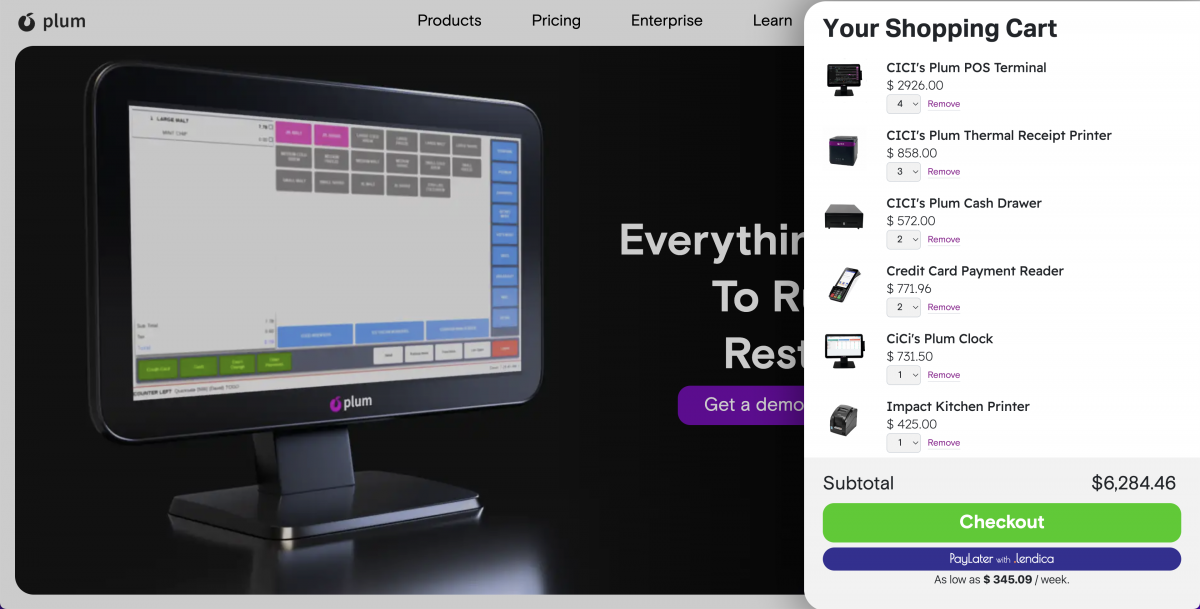
Like many of his fellow Cicis franchisees, Greg has been watching sales steadily increase across his three locations. He’s been pleased to welcome in new customers and welcome back the regulars even more – so much so that he believes it may be time to upgrade. The first step was equipment. Greg, along with fellow Cicis owners, began by updating their Point of Sale set-up to the Plum POS bundle. At checkout, Smith came across the option to PayLater with Lendica.

Lendica’s B2B PayLater option was built to help small and medium sized businesses spread the upfront cost of certain purchases over several weeks. Greg followed the four step application and, in under two minutes, he was approved to pay his $4,616 bill in 5, 10, or 20 smaller installments. He opted for 10 weekly payments of just $470.

Once completed, Greg was directed to Lendica’s customer portal. He was pleased to find that, much to his surprise, his total credit available was $55,600 – far more than the small POS purchase. Since Greg’s business was in good shape and he had been managing his funds appropriately, Lendica was able to automatically qualify him for more capital without the need for an additional application. His credit facility was already available for use! Greg plans to use this line of credit to begin upgrading his stores and is working with the Lendica credit team on additional capital for his arcade renovations and acquisition of new locations.

“The experience with Lendica has been really great,” according to Greg. “The PayLater application was fast and simple and the rates were fair. The fact I can use Lendica for even more equipment and renovation is awesome, too. We’re looking for a partner that can take us to the next level and it seems like we’ve found it.”

Lendica is happy to provide instant, quality capital solutions for Cicis Pizza and many more franchise networks. To learn more, visit Lendica at golendica.com.

Categories
Article

The New Normal in B2B Finance

The New Normal

At Lendica, we spend a lot of time (read: like, a lot) talking about and building towards the future of finance. Here is how we see it, for those eager to waste a few more minutes.

What is a payment? What is a bank? What (the heck) is a fintech? It seems like, faster than you can say “who’s leading the round?!,” the answers are changing.

We recently launched a partnership with Altametrics – the powerhouse technology shop supporting Chipotle, TacoBell, Jamba Juice, and more – and in a matter of two weeks, they have gone from a tech firm to a tech firm that “oh by the way can also instantly qualify and fund you for a loan-type product.”

PayLater with Lendica is an instant payment plan product available on PlumPOS

How is this possible?

Great software for starters 💁‍♀️. More than that, it’s built on the back of a major surge in demand for financing in peculiar places.

“…the [fintech movement] has gone mainstream and people now expect financing products at their fingertips.”

This trend certainly isn’t new – we’d be remiss not to mention the Big A.S.S lenders (Amazon, Shopify, and Square) who led the charge. BNPL giants (read: not at press time) like Affirm and Klarna also get their credit.

In the B2B space, the movement has gone mainstream and people now expect financing products at their fingertips. Companies like Balance, Gynger, and OatFi have taken notice and are building tools in pursuit of glomming on. Customers, especially small and medium-sized businesses, stand to benefit from the influx of targeted software and capital.

With VC money pouring in, payment and finance products on your every screen may very well be the new normal in the B2B world. Show us the odds on Clippy’s come back, “I see you’re typing an invoice.”

What will happen?

The question remains: will the fintechs “play nice?”

When a fintech company integrates with a software provider – Enterprise SaaS, ERP, POS, or ISV – to offer customer’s financing products, they are building what is called a captive market. A captive market is the equivalent of a beer at the ball park. It hits the spot… but for $15?? I guess it’s better than leaving for a six pack…

The convenience may be worth the price, but we believe ease shouldn’t be served at a premium. We’d like you to imagine Coors, Bud, and Miller competing over the sale, right from your seat.

At Lendica, we are on a mission to establish the future new normal in B2B finance – captive market with competitive prices. We draw inspiration from the mortgage, auto, and consumer credit markets.

In the meantime, we are pleased to be a part of the pack pushing for embedded payments, instant lending, and bringing back Clippy.

Categories
Article

How big agg data can help you swallow your burger with a smile

Easterday Farms

Ranchers and their enthusiasts are all too familiar with the tragic story of Easterday Farms. To our audience not yet acquainted with Gale Easterday, formula contracting, or the capitulation of the single family ranchers of America – inch a little closer.

The event which ended in unraveled fraud and a deadly car crash can be summarized, bluntly and apologetically, as an information and incentive mismatch. As entrepreneurs, we empathize with the outcome. As lenders, we recognize the need for change.

To say that big data could have helped avoid the event would be a bold claim. The reality is a more transparent, dynamic system can help ranchers fight back against formula contracting. Importantly, a better alternative to formula contracting can lead to happier ranchers, and thus, maybe even better burgers.

Allow us to explain how.

The cattle ranchers of America are getting squeezed like an udder.

Too big to scale?

Feeding America, the NGO fighting Hunger, places emphasis on scale. Bigger producers and bulk orders means lower prices and better food access. As a result, the price of beef has steadily dropped over the past 20 years. Many ranchers, especially those producing under 50,000 pounds of livestock, are folding under the pricing pressure.

The four major cattle buyers in America – Tyson, JBS, Cargill, and Marfrig – have hit scale through several financial instruments. The most complex, and fastest growing, is called formula contracting. Basically a loan-to-own on young calves, formula contracting is an agreement to prepay ranchers on their calves and buy them back at the market price, plus interest, at their finishing age. 

Small ranchers with cash flow issues rely on this tool to stay afloat. Margins have tightened and, almost in lockstep, the formula contract practice has expanded – today more than 70% of cows are under such terms. 

The buyer is the lender

The danger with these contracts lives in the buyback clause. The buyback price is set on the CME – market participants which include speculators, day traders, and, of course, cattle’s big four. Tyson and gang, already under close watch over shady chicken price practices, have a clear economic incentive to lower the market – especially during the buyback window. 

When a lender finances an operator against their inventory, they are betting on the business and its goods. In a good outcome, the business sells its inventory and pays off their debt. Alternatively, the business defaults and the lender liquidates the inventory into the free market. 

Formula contracting is a different story. The better outcome for Tyson is a default scenario. If the price of cattle takes a hit, the buyer’s purchasing power increases. They receive their cattle at a much lower rate, collect interest, and if the rancher cannot pay can trigger aggressive default clauses. 

Since the rancher cannot sell their only major asset to “the market,” they have no choice but to meet the buyer’s demands. This may include giving up more cattle, racking up penalties, or even losing their farm.

For those arguing the market price is set by the CME and it’s impossible to arbitrage the transaction, remember this: private cattle transactions do not have to trade at listed prices. If a bad actor artificially deflates the futures market, the rancher can still sell off-market at a fair price. That is not an option when there is only one buyer

Create a new system

Though flawed, the formula contracting system is built on some solid ground. The ranchers need a cash advance on their future cattle sales. The lender needs protection for its risk. We believe the solution lies in introducing a third party.

When a third party lender can properly assess risk and contract in the free market, the operator wins. The business has more latitude to manage their cash flow without an imposing threat of a “margin call” (frankly, they have enough to worry about).

Third party lenders should also have an edge in underwriting. Granted Tyson & Co. have an intimate knowledge of the ranching market, we believe that risk can better be quantified using data. Today’s smart lending outfits look more like Facebook than Bank of America with engineers building tools to measure and track risk. Tyson failed to recognize millions of Easterday’s cattle left unaccounted for. A cutting edge lending software may have caught such malpractice.

Lendica’s We Heart Ranchers Program

At Lendica, we want to put an end to formula contracting using, you guessed it, lots of data. Today, savvy ranchers are using state of the art ranch-management software to track cattle, monitor feed, and process billing. That same software can soon be used to share information with lenders and quickly offer financing. Lendica believes that by empowering ranchers to seamlessly share their data, easily understand loan documents, and instantly access capital we can build a more sustainable credit infrastructure for the ranchers of America. And, with that, hopefully a better burger. 

To learn more about the Lendica We Heart Ranchers or sign up for our waiting list, click here.

Categories
Article

How Supply Chain Vigilance Impacts Credit Risk

“I’ll have the usual”

As a frequent visitor of South Street Diner, Boston’s historic 24 hour greasy spoon, I had the pleasure of calling for “the usual” and diving into an omelette just minutes later.

Breakfast after breakfast, “the usual” was ordered and happily consumed. It became my default behavior. I was hooked.

After an apartment change and a six month South Street hiatus, I returned to the diner to find a new chef and tweaked menu behind the same friendly waitstaff. The usual order (she remembered!) was met with runny eggs, a bigger bill, and a search for a new breakfast spot. 

Quality changes, prices move and customers update.

A Boston staple or default option?

“Same as last week?”

Small businesses today rarely have enough time to measure the quality and cost of their many product inputs. Even more rarely do they find time for a nice breakfast. Yet, without keeping a keen watch over their vendors, and how the market is responding, businesses run a real risk of losing clients. Responsible management of the supply chain has a major impact on future happy customers.

What is the supply chain? Though Websters defines it as an utterance used to signal relevance, we know it as a network of human-made transactions. We have discovered, much to our delight, that emotion beats out rationality in most of these decisions.

Retailer interviews confirmed our sneaking suspicion that ordering the “same as last week” is a great substitute for inventory optimization. The sales and delivery team have families, bring donuts, and offer banter on last night’s game. Why adjust one’s ordering pattern and risk losing insight on the MLB lockout?

Laziness means risk

As it turns out, customers’ tastes change. In fact, it is highly unlikely that the best selling product is still the fan favorite just three months later (83% chance of change in top performing product). Same-as-last-weekers run a serious risk of tying up cash flow in slow inventory, missing out on future winners, and turning to the discount crutch.

At Lendica, we sort on smart operators. Our Vigilance Score, one of several behavioral indicators, uses vendor purchase invoices to sniff out the same-as-last-weekers. We compare historical purchase behavior relative to future sales, on a per product basis. The underwriting model, trained on millions of transactions, penalizes lazy ordering and rewards vigilant decision-makers. 

Future free cash flow, or cash generated net of goods and expenses, is directly impacted by laziness in the supply chain. Less vigilance and slower inventory turn negatively affects cash flow and makes it harder for borrowers to pay back their debt on time. 

When we can separate lazy and vigilant operators, we can optimally price the risk of each financing – especially every invoice financed using Lendica’s PayLater. 

And, of course, better risk pricing means better rates for our customers!

For a more detailed explanation on the Vigilance Score and some other behavioral indicators  (Helter Skelter Score, Generosity Score, Diligence Score, etc.), click here to schedule a call.

Categories
Article

How savvy suppliers can turn any buyer into their “McDonalds”

Perfect World

A supplier and its buyer have the same goal: get the best possible product to the end customer. So why don’t all buyers and sellers simply get along?

In a perfect world, a supplier should seek to maximize value to its buyers. Its customers’ success invariably leads to more orders, larger SKU counts, and, if supplier executives are lucky, a bigger paycheck come Christmas. Buyers ought to feel the same way. A fair deal to a vendor can lead to a stronger supply chain with less disruptions. Afterall, if a supplier runs out of cash and stops supplying, their buyer runs that same risk.

At Lendica, we don’t always witness such a smooth supply-chain scenario. We have found the breakdown typically begins with net seller terms.

Setting net seller terms, a topic we discuss ad nauseum, is often a function more of art than science. The option to pay after delivery requires a complex calculus that weighs the perceived credit risk of the buyer, one’s current financial stability, and the potential for future business. The heuristics involved in this decision-making process likely warrants a separate post.

We instead explore a separate, critical issue in supplier relations. Once a customer is offered NetX, how do you assure it doesn’t become NetY? Said differently, how do you get your customers to pay you on the agreed upon date?

McDonald’s Case-let

First, a brief divergence to dissect a supply chain maven, Ray Kroc. For those turned off by Kroc’s portrayal in the movie The Founder, it’s worth noting the McDonald’s entrepreneur employed impressive diplomacy and effectiveness in managing his supply chain.

In McDonald’s early days, the burger (read: real estate) tycoon struggled to maintain positive cashflow during an aggressive expansion period. Despite a relatively simple menu of burgers, milk shakes and fries, Kroc and team had to corral an extensive vendor network to meet strict quality control. The fast-food chain sourced buns, for example, from several bakeries across the country – each of which were scrutinized over size, taste, and even sesame seed count.

The french fry was McDonalds secret weapon during early-days expansion.

Many pressured Kroc to bring manufacturing in-house. Even your average MBA could calculate the potential cost savings from a “simple” vertical integration. Kroc wouldn’t listen. He knew that his business’s core competency was retail and felt that the minute you begin “selling the product to yourself” is when you start flaking on quality.

Instead, he put trust in his vendors to create the best product at a fair price and, when he found a vendor that was to his liking, sought ways to grow the relationship instead of threatening it. (Kroc famously pulled a baker out of early retirement and moved him to California to support west coast expansion – a deal that paid off for both companies). Supplier goodwill was one of the key drivers to McDonald’s successful scale in the 60s and 70s – a considerable loan from several suppliers even saved the business in the early days. The goodwill, of course, was repaid by McDonalds’ with massive contracts and timely payments.

In short, Kroc’s long-term trust in his suppliers, and vice versa, was primarily a fair exchange which greatly benefited all parties involved.

Ability vs. Willingness

Today’s suppliers are not typically enamored by the idea of extending a loan to a struggling buyer. Yet, a poorly managed net-seller program is effectively a zero-interest loan! When a buyer receives goods ahead of their payment, the seller has limited recourse – aside from holding future orders and pleading pretty-pleases. The buyer is taught to conserve cashflow at all costs – each with their own set of tricks and tales to push back sending funds. Each day that passes represents a higher chance of default and an implied discount on the sale.

Lendica Lens 🔎

Interestingly, the buyer often has the ability to pay for the goods but lacks the willingness to do so.

Our analysis of tens of thousands of invoices suggest that buyers oftentimes are able to make a payment but still delay several days past due. We attribute lack of buyer willingness to a variety of behavioral traits including the Pain of Paying (Zellermeyer) and the Availability Bias (Kahneman/Tversky) – buyers are constantly introduced to new manufacturers and undervalue the high switching costs associated with changing a supplier or bringing operations in-house.

As a result, buyers may apply implicit discounts to their supplier relationships and, perhaps without realizing, justify the delayed payments beyond the agreed upon terms (e.g pay a Net7 invoice in fourteen days). Advances in digital marketing may increase the occurrence of the Availability Bias and, in parallel, decrease a buyers’ willingness to pay.

The Savvy Supplier

It would appear that, short of sorting on Ray Kroc enthusiasts, good buyer management protocol is a major challenge. Finding buyers is hard enough, let alone those willing and able to pay according to schedule. Lending money to struggling customers is not always feasible (or wise) but taking risk to support their growth can prove to be a profitable endeavor. How does a savvy supplier manage the process?

Using a supply chain management partner, such as Lendica, is oftentimes the best approach. Here are a few key benefits:

  • Dynamic Seller Terms. It is important to remember that each invoice is a unique transaction which requires a detailed analysis. This includes consideration of buyer credit risk, your current cash position, and the likelihood of future orders. Supply chain management tools offered by Lendica allow sellers to treat each invoice as a unique transaction and helps price the risk accordingly.
  • Leverage the Pain of Paying. The cost of a 5c bag at many grocery stores is by no means a ploy to grow revenue. Instead, it is a clever, state-mandated initiative to incent shoppers to reduce plastic bag consumption. Five cents is not a financial hurdle that deters most customers, but the sheer act of introducing another cost has proven to be a successful measure to changing behavior. Your supply chain management tools should include nominal late fees and a variety of nudges to alter buyer behavior. Lendica has seen several cases where the pain of paying even a $25 late fee can speed up collection time on invoices, regardless of order size.
  • Focus on Customer Success. The availability bias should work to your advantage. Most suppliers are in constant communication with their customers to share updates on their products and promote new ideas. Challenges may arise when those updates are dominated by collecting overdue invoices. This shifts the tone of the discussion and can lead buyers to negatively update. Outsourcing your accounts receivable ensures prickly conversations are handled outside the organization and dramatically reduces the chance of negative buyer sentiment.

Finding a long-term, consistent buyer is the goal of any supplier. Realizing this goal requires a deep understanding of risk pricing and buyer behavior. The McDonalds’ team benefitted from their visionary leader Ray Kroc and his unique perspective on vendor management. Most suppliers don’t have the fortune of securing contracts with an icon.

For suppliers that want to help buyers manage their cashflow and support growth – like the early-days McDonalds’ vendors – while still effectively managing their own business, a supply management tool like Lendica is often the answer. Providing net terms, sending small nudges, and outsourcing collection calls can help improve buyer relationships and, most importantly, allow the supply chain to focus on creating a winning product.

Categories
Article

The Future of Embedded Finance

“What the [heck] is a bank branch?”

Each year, my highschool and college students are presented with a slide from the CFA Financial Literacy curriculum entitled: Big Banks vs. Small Banks. The material, developed no more than five years ago, argues one should consider the number of bank branches when deciding which bank to use. “A major benefit of bigger banks is they have more branches! More branches leads to better customer experience and added convenience…” It’s as if Bank of America sponsored the course. 

Each year, without fail, hands shoot up from across the classroom. It’s always the same question, “What the [heck] is a bank branch?”

It is possible, someday in the not so distant future, we too may no longer know.

The information age, with an assist from a nationwide lockdown, has catalyzed the digitization of banking services like payments, cash management, and lending. Lendica is likely not alone in thinking we are just at the beginning.

“Lollipop on the way out.”

Today, the average person spends roughly 10 hours per day staring at a screen. That number surpasses 12 when you filter by the regularly employed. It’s only natural that banks are going digital to reposition themselves in front of the next generation of customers. 

The challenge is, be it brick and mortar or online, we still don’t like going to a bank. It’s no coincidence that banks place a bowl of candy in the line. You are offered a lollipop on the way out to help justify the painful experience. 

Dealing with finances, personal or as a small business operator, is often stressful stuff. We don’t check our credit score because we’re worried it’s low. We don’t look at our bank balances because we fear the same. When you add unnecessary hurdles such as a confusing process, excessive wait times or required travel, it’ll take more than a few suckers to get someone to engage. 

The digital banking renaissance is supposed to solve for this. What we have found, even with endless automation and mobile convenience, is the industry is far from a satisfying solution (dare we say: several licks away from the center). 

“Simple, fast, and here.”

Ask Kabbage 10 years ago and they would tell you they are changing the world. Ask BFS Capital (now Nuula) 20 years and they would argue the same. In fairness to these two disruptors, they certainly did. 

Access to small business funding transitioned from hopelessly pleading with your bank to warding off MCA brokers “selling you cash” in under a decade. We won’t comment on whether these MCA options are any good (hint: they are not) but we will commend the creation of a roughly $100bn credit market. 

These two businesses have dramatically changed. Yet, even with their new owners or facelift, we’d argue that they still miss on the three most important dimensions – simplicity, speed, and location. We can run them and others through the Embedded Checklist: is it simple, is it fast, and is it here?

Kabbage, FundBox, Pipe, […. insert your favorite internet lender] are moving in the right direction. The web applications are designed to be simple – often allowing one to “connect apps” with a few clicks. The speed has improved – usually you’re funded within 24 hours. The location is creeping closer – online just like their customers! 

That said, we examine these companies’ exorbitant cost of customer acquisition to suggest they are far from perfect options. Why is it so expensive to get and keep customers?

“Embedded sounds good.”

Technology companies have been making waves in the lending space for some time. Perhaps you’ve read our piece on the Big A.S.S lenders (Amazon, Shopify, and Square) and their success in small business financing.

The business case for technology vendors as lenders (“tech lenders”) is simple. Tech lenders generate real-time data that their customers rely on to make decisions on business operations. That same data can be used to assess credit quality. The beauty of this data, also known as Truth Files, is its immutability. Lenders and customers can put aside Akerlof’s lemon problem and trust the data is reliable and symmetric. 

Technology companies are increasingly seeking tech lender solutions. The build, rent, buy discussion usually lands on “embedded sounds good.” Embedded finance companies are designed to easily consume the Truth Files, perform an underwrite, and then return the customer an offer. This can be any form of lending, insurance, banking, or payments solutions. 

How does the average “embedded fintech” perform on the Checklist?

Simplicity and speed. These all depend on execution. The best embedded finance products must include a beyond simple application process and instant decisioning. This is typically born from management teams with years of small business funding experience – both underwriting and platform research. 

Here. The execution on location is subtle but arguably most important. The customer should never have to leave their current webpage. Anything else is just a referral link. 

“The most valuable real estate.”

Back to our Financial Literacy students. Where will the future small business leaders be spending their time if not walking past bank branches? We begin by defining a small business. In its simplest form, it is an organization made up of a product, data to fine tune it, and capital to execute on it. We recall countless stories of small business operators up at night staring at the computer screen. The decisions made to guide their business are driven by the data consumed from their technology vendors.

It should come as no surprise that technology vendors – POS, ERP, Payments, Ad-tech, Talent Management, etc. – will continue to see the most digital foot traffic and likely become the most valuable real estate for a financial institution. 

Therefore, technology vendors should be ultra-selective – embedded finance platforms that do not check all three of the boxes (simple, speed, and here) run the risk of lost rent. If a customer cannot silently share data, instantly access an offer, or navigate the tools from their current webview it is not an embedded finance solution. 

“So what’s the future?”

Building a fully embedded solution takes time and resources. The technology lift is an ongoing challenge, the underwriting efforts require a growing team, and the balance sheet management is not trivial. It is no surprise that many technology vendors are outsourcing these operations. 

There are additional considerations including portfolio diversification, use of equity dollars, types of funding products, evolution of services, and cost of capital. We’ll drill in on the last one. 

Banks do serve a few good uses beyond the occasional hard candy. Namely, their bank charter allows the institution to draw funds from the federal government at the lowest possible rates. Small or mid sized technology vendors rarely qualify for a bank line of credit. Their customer concentration, limited compliance, and platform equity risk scares off most banks and leaves alternative credit funds to fill the gap at higher rates!

So what’s the future?

Our vision is simple. Imagine one embedded finance platform that any technology vendor can easily install. The platform is designed with user simplicity in mind, offers instant decisions, and can be quickly launched or hidden without leaving the current webpage. It’s equipped with simple funding products designed for several use-cases (revenue-based finance, supply chain, etc). Customers can manage all of their finance products across several technology vendors or all directly from their mobile phone. And finally, since the borrower-base is sufficiently diversified, customers can access the most affordable financing options on the market. We believe this model exhibits the perfect embedded finance solution

The banking world is quickly changing and today’s industry leaders will undoubtedly be disrupted. We eagerly await more innovation in embedded finance and invite you to join this discussion.
Categories
Article

Are you offering your SMB customers lending? Here’s why you should.

The Big A.S.S lenders, Amazon, Shopify, and Square, are three of the largest small business (“SMB”) financiers in the country. If you offer eCommerce, Supply Chain, Payments or Point of Sale solutions to SMB customers and do not also have a lending arm, you are at risk of losing clients.

Small business struggles

Access to capital is one of the major challenges for small businesses across the country.

Did you know that only 2.7% of loans to small businesses are funded by the SBA?

As a result, small businesses seek capital from banks and alternative lenders. These two solutions have been historically unreliable, slow, and at times very expensive. Worse, community banks and thrifts have been consolidating or folding during a low yield environment reducing the already limited credit options for SMBs.

SMBs need better solutions to finance their growing businesses.

Tech fills the gap

The challenger banking model, a b-school buzz word that loosely translates to “technology companies now lend,” has been a largely successful alternative to traditional banking.

One of the keys to success is, of course, the data.

Technology companies, perhaps even like the one you work for, hold some valuable data about the performance of their business customers. Point of Sale companies can track, in real-time, revenue of a business. ERP/Inventory management companies can see the evolution of order sizes and SKUs sold. These are great barometers for the success (read: credit risk) of a small business.

Data becomes the ultimate form of collateral.

The Big A.S.S lenders, and many of their smaller competitors, have invested heavily to build sophisticated systems that, securely and simply, allow their customers to leverage their business data to get quickly qualified for funding. The platform gets an additional revenue stream and the customer receives instant capital to plow back into the business. Laymen refer to this as a win-win.

The business case

The reasons to offer lending extend beyond just additional revenue and happier customers. Adding a financing solution to your technology service has become more than just a trend — it is approaching default behavior.

Small business customers may now expect their technology vendor to offer some form of financing product.

Importantly, software companies that offer these lending solutions are winning business over competitors. Even customers that do not currently have borrowing needs are sorting based on this added service assuming they eventually will need it!

Getting started

Creating a small business lending division requires a serious investment. Specialists are required to build the application and underwriting processes, price the credit, manage the balance sheet and handle collection.

If you are considering bringing this process in-house, be prepared for a 24 month rollout and a minimum $2,500,000 investment (not to mention credit losses in your first 12 months of operations).

Alternatives exist to get operational in just a few minutes. Lendica, a truly embedded financing platform, offers an industry leading, full-service lending application that is installed in seconds. Lendica provides the underwriting software and capital to fund the deal which means your customers can get funded instantly. Technology vendors can now generate incremental revenue while providing a value-add service that their customers will soon expect — all with just a few lines of code!

As small businesses continue to seek alternative sources of financing, they will increasingly turn to their technology vendors to help with bite-sized funding solutions. Now is the time to fight back against the big A.S.S lenders and offer them yourself!

Categories
Article

How to provide supplier terms to your customers?

Your competitors are offering terms. Are you?

What are supplier terms? In many industries, it is common for suppliers to provide net 45 day terms. Simply put, the customer is allowed up to 45 days to pay the invoice even after the product has been ordered or delivered.

Why do suppliers offer terms? Cash is king! A common adage passed around business school classrooms (zoom chatrooms), the concept of preserving cash at the expense of financing fees or supplier relations is a focal point of CFOs everywhere. The longer your customers can wait to pay for your goods, the more money they can sink into growing their business.

What do I need to provide supplier terms? A balance sheet (cash is king, remember?)! We would all love to be generous and hand out terms like it’s Halloween, but sadly it is quite expensive and requires significant cash balances. Remember, customers don’t always pay and your business still needs cash to run its operation. A simple rule of thumb when considering offering terms: you should have access to enough cash on your balance sheet to continue operations if 20% of your customers don’t pay!

How else can I provide supplier terms? If you are running tight margins or do not have a full-time A/R department, it might be better to outsource this function to experts. Third-party finance companies, like Lendica, are designed to help businesses of all sizes tap external balance sheets to make it easier to offer terms. Lendica was built specifically to handle the underwriting, funding and collection of payments/invoices in all high growth industries.

Sounds great… so how does it work? Your customers who ask for supplier terms can instantly qualify with Lendica. When you share the invoice along with basic customer details with Lendica, your customer receives a simple link to share a bit more information on their business. After completing the two minute application, Lendica’s system processes the data and presents them with an offer. Once accepted, Lendica pays you for the invoice on day one, you fulfill the order, and your customer pays Lendica over simple installments. That’s it!

How do I get started? Lendica’s embedded finance technology may already be available with your inventory management system, point of sales provider, or bank. Check our list of partners, here. If not, you can contact us directly to set up your own, dedicated supplier term portal.

Categories
Article

The Lemon Problem of Lending

The Lemon Problem of Lending

Why premium borrowers get squeezed.

The Lemon Problem, famously presented by George A. Akerlof in The Market for “Lemons”: Quality Uncertainty and the Market Mechanism, discusses how asymmetric information leads to an ineffective market.

Now [on to lamens terms], this research shows how both buyers and sellers can arrive at a suboptimal price simply because they do not share the same information.

Here’s why:

A buyer, knowing they’re out of the know, cannot tell whether their desired item is a premium good or a lemon. Using simple heuristics (fancy way of saying “no clue”), the buyer offers an average price — somewhere between the premium item and lemon item.

Asymmetric information leads to suboptimal pricing.

When the product is in fact a clunker, the seller wins! The price transacts above the “Item Value” and the difference is their profit. Sadly, and all you quality borrowers best listen up, the seller of the premium item is penalized. The buyer cannot know for certain it’s a premium good and purchases at the average price — below the Item Value (in the chart above, the Item Value is the top of the green box). Again, a profit is pocketed — this time going to the buyer.

On to lending…

If we replace “Seller” with “Borrower” and “Buyer” with “Lender” we have a similar landscape with slightly different outcomes.

Once again, in almost any case, the Borrower knows more about the business than a Lender. [If not, you may have yourself a lemon :)]. The Lender will not be able to offer the “Item Value,” or true price for your loan, because they do not have enough information to tell Borrowers apart.

What’s worse, the average price is likely not the mid-way point between good and bad. When a loan defaults, the lender can lose up to 100% of its principal. This means they’ll need to make many more good loans to make up for their losses. The result is a much bigger gap between the Item Value and Average Price.

The lender profits on good borrowers at the expense of bad borrowers.

As you can see, the Premium Loan — the quality borrowers running strong operations— are getting poor pricing to make up for the Lemon Loans. The Lender does not have enough information to tell them apart and, like Akerlof’s famous Lemon Problem, are pricing them accordingly. As pleasing as the colors are above, if you are a premium borrower it is not a pretty picture.

Enter Lendica

Lendica has had enough with Akerlof and his lemons.

In today’s information era, there is no excuse for lenders mispricing loans, working capital, factoring or lines of credit. Your business is already teeming with data — POS systems, card processors, inventory tracking, banking, wholesalers, security footage — the list goes on.

So what happens when life gives you data? [Punchline has been removed for obvious reasons]

Lendica helps you take the data that exists throughout your business and add it to your credit profile. We make it simple to export, share, or simply SSO your vendor data into our system. We then use your entire credit picture to offer you the best possible rate.

Remember, it is your data, so make it work for you!

So the next time you get a loan quote and think to yourself, “am I really a lemon,” just remember — only the highest quality borrowers get squeezed. And when you’d like a chilled, refreshing change, come check out Lendica.