Categories
Article

Comparing the Best Embedded Lenders for Accounts Payable

Comparing the Best Embedded Lenders for Accounts Payable: C2FO, Resolve, Settle, and Lendica

Managing accounts payable (AP) financing effectively can significantly enhance a business’s cash flow and financial efficiency. This post compares four top embedded lenders that offer accounts payable financing or reverse factoring products: C2FO, Resolve, Settle, and Lendica, highlighting their key features and benefits.

Who are the Top Embedded Lenders for Accounts Payable?

1. C2FO

Overview: C2FO offers flexible early payment options with low fees and seamless ERP integration. Their Name Your Rate® technology allows users to set discount rates, providing customizable solutions.

Funding Speed: Payments can be received as soon as the next day.

Advance Rates: Typically between 80-100%.

Technology: Robust platform with features like Invoice Central for easy management. This enables businesses to accelerate payments and manage cash flow efficiently without changing existing invoicing processes    .

2. Resolve

Overview: Resolve focuses on net terms and cash advances, integrating with common ERP and accounting systems for automated invoice processing.

Funding Speed: Often within days of invoice approval.

Advance Rates: Up to 90%.

Technology: Advanced integration and automation for seamless management. Resolve leverages the buyer’s creditworthiness to offer lower fees and ensures quick access to working capital, making it a reliable choice for improving cash flow    .

3. Settle

Overview: Designed for AP automation and working capital solutions, Settle offers strong integration with accounting software and ERP systems.

Funding Speed: Typically within one business day.

Advance Rates: Up to 100%.

Technology: Comprehensive automation for invoice capture and approval. Settle’s platform helps businesses streamline their financial operations, saving time and reducing manual errors  .

4. Lendica

Overview: Lendica stands out with extensive connectivity, integrating with all public and private ERP and POS systems. Their AI-powered underwriting expands access to capital.

Funding Speed: Instant funding decisions, typically within 24 to 48 hours.

Advance Rates: Up to 100%.

Technology: Advanced AI for smarter underwriting and streamlined processes. Lendica’s broad connectivity and rapid funding make it an exceptional choice for businesses seeking efficient and flexible AP financing solutions.

Unlock new capital for growth.

Apply now and receive capital within 24 hours.

Apply now

Comparing the Best Embedded Lenders for Accounts Payable
Category C2FO Resolve Settle Lendica
Fees Typically low fees based on discount rates set by users. No upfront costs or hidden fees. Fees vary; usually lower than traditional factoring, leveraging buyer’s credit rating. Fees depend on services; competitive and transparent for AP automation and working capital solutions. Rates start at 1% for 30 days.
Integration with ERP & POS Systems Seamless integration with various ERP systems; no changes required to invoicing processes. Integrates with common ERP and accounting systems, providing seamless invoice management. Strong integration with accounting software and ERP systems to streamline AP processes. Connects to all public and private ERP and POS systems, offering the widest connectivity in the market.
Loan Terms & Flexibility Highly flexible; users can choose which invoices to accelerate and set discount rates. Flexible terms based on buyer’s creditworthiness, ensuring favorable rates and terms. Flexible working capital and AP solutions with customizable terms based on business needs. Delay vendor payments up to 90 days with flexible payback schedules.
Funding Speed Payments can be received as soon as the next day after terms are agreed upon. Generally fast funding, often within days of invoice approval. Rapid funding, often within one business day for qualified invoices. Instant funding decisions, with quick access to funds, typically within 24 to 48 hours after approval.
Advance Rates Typically between 80-100% depending on agreement with the buyer. Up to 90% of the invoice value, depending on buyer’s credit rating and terms. High advance rates, often up to 100%, subject to invoice and buyer terms. Advance rates up to 100%, leveraging AI for smarter underwriting decisions.
Technology & Automation Features Robust platform with features like Name Your Rate® and Invoice Central for easy invoice management and early payment requests. Advanced technology for seamless integration and management of reverse factoring processes. Comprehensive automation for AP processes, including invoice capture, approval rules, and integration with accounting systems. Advanced AI-powered technology for underwriting and automated processes. Integrated with ERP and POS systems for streamlined loan and payment processes.
Eligibility Requirements Accessible to small and mid-sized businesses; eligibility depends on buyer’s participation in C2FO program. Based on buyer’s creditworthiness; favorable for suppliers with reliable buyers. Suitable for startups and growing businesses; flexible criteria based on business needs and customer profiles. Tailored to small and medium-sized businesses with specific requirements based on industry and business model. Expands reach beyond typical lenders using AI.

Why ERP Integration Matters as an Embedded Lender Paying Vendors

Enhance Efficiency

ERP integration ensures that all financial transactions and data are synchronized seamlessly. This automation reduces manual entry errors, saves time, and enhances overall efficiency in managing accounts payable. By integrating with ERP systems, embedded lenders like Settle and Lendica enable businesses to manage their invoices and payments within the same platform they use for other financial operations.

Improve Cash Flow Management

Real-time visibility into payable and receivable accounts is crucial for effective cash flow management. Embedded lenders that integrate with ERP systems provide businesses with up-to-date information on their financial status, helping them make informed decisions and maintain a healthy cash flow.

Simplify Operations

Integration with ERP systems streamlines financial operations, reducing administrative burdens and freeing up resources for other critical business activities. This simplification is particularly beneficial for small and medium-sized businesses that may lack the resources to manage complex financial processes manually.

For instance, Lendica’s ability to connect with all public and private ERP and POS systems ensures seamless transactions and data synchronization, making it easier for businesses to manage their AP processes effectively.

white wooden table near brown chair
Simplify your process whenever you can.

How to Save Money with Embedded Lenders for A/P

Lower Fees

Choosing the right embedded lender can lead to significant cost savings through lower fees. Lenders like Resolve and Lendica offer competitive rates by leveraging the buyer’s credit rating, which can reduce the overall cost of financing. These lower fees make it more affordable for businesses to access the capital they need to maintain operations and growth.

Automation

Automation features provided by embedded lenders save time and reduce the need for manual intervention in AP processes. For example, Settle’s comprehensive automation capabilities help businesses capture invoices, manage approvals, and process payments more efficiently, reducing the time and labor costs associated with these tasks.

Instant Decisions

Lendica’s AI-powered platform provides instant funding decisions, reducing the wait time and administrative overhead associated with traditional financing methods. This rapid decision-making process allows businesses to access funds quickly, improving their cash flow and operational efficiency.

By utilizing these cost-saving features, businesses can manage their AP financing more effectively, reducing expenses and improving overall financial health.

Lendica’s AI-powered platform provides instant funding decisions… allowing businesses to access funds quickly, improving their cash flow and operational efficieny.

Lendica Lens underwriting guide

The Importance of Eligibility Requirements When Seeking an A/P Facility

Broader Access to Capital

Eligibility requirements play a crucial role in accessing AP financing. Lendica’s AI-driven underwriting expands access to capital by evaluating a broader range of data points, making financing available to more businesses, including those that might not qualify under traditional criteria. This inclusivity is particularly beneficial for small and medium-sized businesses seeking to improve their cash flow.

Flexible Criteria

Settle and Lendica offer flexible criteria tailored to business needs, ensuring that startups and growing businesses can access the funds they need. These lenders consider various factors beyond traditional credit scores, allowing more businesses to qualify for financing and maintain healthy cash flow.

By understanding and meeting these eligibility requirements, businesses can secure the AP financing they need to support growth and stability.

Unlock new capital for growth.

Apply now and receive capital within 24 hours.

Apply now

Conclusion: Lendica Outperforms Top Rated Embedded Lenders in Accounts Payable Financing

Lendica stands out among top embedded lenders for accounts payable financing due to its unique features:

Extensive Connectivity: Integration with all public and private ERP and POS systems ensures seamless transaction handling and data synchronization.

AI-Powered Decisions: Smarter underwriting decisions expand access to capital, making financing available to a broader range of businesses.

Instant Funding: Quick access to funds with instant decisions and high advance rates up to 100%.

By leveraging advanced technology and providing broad connectivity, Lendica offers unparalleled benefits, making it the superior choice for businesses seeking efficient and flexible AP financing solutions.

Categories
Article

How to Use 2/10 Net 30 to Get Free Financing

If you’re a business operator looking for ways to optimize cash flow and boost your company’s financial health, leveraging the 2/10 net 30 payment terms is a smart strategy. Here’s how you can use this technique to secure free financing for your business.

What is 2/10 Net 30?

The 2/10 net 30 payment terms mean that if you pay your invoice within 10 days, you receive a 2% discount. If you don’t take the discount, the full payment is due in 30 days. This can be a great way to save money, but many businesses overlook the potential for using this term strategically to get free financing.

Understanding 2/10 Net 30

2: The discount applied to an early payment

10: The number of days after an invoice has been issued. For example, if an order is delivered on Jan 1st, the 10 days would refer to payment made on or before Jan 11th.

Net 30: The terms provided without a discount. For example, the same order delivered on Jan 1st would be due by Jan 31st at par value.

Note: This is a simple naming convention, but the prices may change. Your vendors may charge a larger discount (say, 3%) for earlier payment or offer a full price beyond 30 days (say, net 45).

Why Do Vendors Offer Discounts

Vendors offer 2/10 net 30 discounts to accelerate their cash flow and reduce the risk of non-payment. By incentivizing early payment, they can receive funds more quickly, which helps in managing their cash more effectively, reducing the need for external financing, and lowering financing costs. Additionally, offering such discounts can strengthen customer relationships, create a competitive advantage, and reduce administrative costs associated with managing accounts receivable. This strategy helps vendors maintain a steady flow of funds, optimize inventory management, and improve overall financial stability.

Step-by-Step Guide to Get Free Financing Using 2/10 Net 30

Using 2/10 net 30 terms with a reverse factoring company allows businesses to secure 10 days of free financing. By negotiating these terms with your vendor, partnering with a reverse factoring company to pay the invoice on the 10th day, and then repaying the factoring company within 30 days, you save the 2% early payment discount while paying the reverse factoring company, typically, 2% or less.

In fact, according to a recent McKinsey & Company report, reverse factoring is one of the fastest growing forms of financing. This strategy boosts your cash balance, enhances liquidity, and creates opportunities for growth, ultimately increasing your business’s enterprise value.

Delay vendor payments with PayLater

Learn how you can pay your vendors early, enjoy early-pay discounts and pay back up to 90 days later.

Learn more

How to Get Started

1. Negotiate 2/10 Net 30 Terms with Your Vendor:

Discuss the early payment options with your vendor and encourage them to offer 2/10 net 30 terms. This is the foundation of the strategy.

Hint: Your vendor may not immediately offer 2/10 net 30, but they will often take a discount for early payment. Start the conversation by asking your vendor if they take an early pay discount – they may be more open than you think!

2. Work with a Reverse Factoring Company:

Partner with a reverse factoring company that will pay your invoice on the 10th day. By doing this, you take advantage of the 2% discount offered by the vendor.

Reverse factoring companies may charge less than the 2% discount offered to your vendor. Before committing to terms, work with your reverse factoring partner to see if you can pay under 2%.

brown concrete street surrounded by buildings
Remember, reverse factoring companies may charge less than the 2% discount so be sure to negotiate your offer.

3. Instruct the Reverse Factoring Company to Pay Your Vendor on Day 10.

This process may be manual, but where possible work with a reverse factoring company that utilizes technology to facilitate the process. This is typically in the form of an invoice portal that can help manage your payments and reporting.

Make sure to maintain good communication with your vendor and reverse factoring company. This strategy is dependent on your vendor receiving timely payment and accepting the discount.

4. Pay Back the Reverse Factoring Company on Day 40:

Once the invoice has been paid, you will typically have 30 days to pay back the reverse factoring company. Typically, the fees charged by the reverse factoring company for this service will be around 2%, but may be less.

Hint: It may be worth exploring long payypment options with your reverse factoring company. Many financiers will extend your due date from 30 days to 60 or 90 days for an additional fee, often called a factor rate. Depending on the offer, this may be a good option to pull out cash from your working capital cycle.

Fees charged by the reverse factoring company… will be around 2%, but may be less.

Make sure to negotiate with the lender to drive lowest price.

Delay vendor payments with PayLater

Learn how you can pay your vendors early, enjoy early-pay discounts and pay back up to 90 days later.

Learn more

Benefits of Reverse Factoring on 2/10 Net 30

1. Free Financing for 10 Days:

By using the reverse factoring company, you effectively get 10 days of free financing. You save the 2% discount and then pay it as a fee to the reverse factoring company without any additional cost.

2. Boost Cash Balance:

This strategy helps you maintain a healthier cash balance, providing more liquidity for day-to-day operations or unexpected expenses.

3. Increase Growth Opportunities:

With improved cash flow, you have more opportunities to invest in growth projects, whether it’s expanding your product line, investing in marketing, or improving infrastructure.

4. Grow Enterprise Value:

Enhanced cash flow and better financial management can lead to an increase in your business’s enterprise value, making it more attractive to investors and stakeholders.

Why Every Business Should Use Reverse Factoring on 2/10 Net 30

This simple yet effective technique allows you to optimize your payment terms, improve cash flow, and get free financing without taking on additional risk. It’s a strategy that every business operator should consider to enhance their financial health and drive growth.

By strategically using 2/10 net 30 terms and partnering with a reverse factoring company, you can turn a standard vendor payment term into a powerful financial tool. Start implementing this technique today and see the positive impact it can have on your business’s financial stability and growth potential.

Delay vendor payments with PayLater

Learn how you can pay your vendors early, enjoy early-pay discounts and pay back up to 90 days later.

Learn more
Categories
Article

What is Reverse Factoring and How Wholesalers are Utilizing

Introduction to Reverse Factoring

In the evolving landscape of supply chain finance, reverse factoring is emerging as a transformative solution. Particularly within the wholesale business space, this financial tool is gaining traction for its ability to optimize cash flow, reduce credit risk, and strengthen supplier relationships. This article delves into the details of reverse factoring, its operational mechanics, and the compelling reasons behind its rapid adoption across many sector.

What is Reverse Factoring?

Reverse factoring, also known as supply chain financing, is a financial solution where a third-party financier, typically a bank or a specialized financial institution, facilitates early payment to suppliers on behalf of the buyer. Unlike traditional factoring where suppliers seek financing against their receivables, reverse factoring is initiated by the buyer to ensure their suppliers get paid faster. This shift in approach provides significant benefits to both parties involved in the transaction.

Delay supplier payments with Lendica

Learn how you can pay your suppliers early, enjoy early-pay discounts and pay back up to 90 days later.

Learn more

How Reverse Factoring Works: A Step-by-Step Guide

1. Agreement Setup: The buyer begins by entering into an agreement with a financial institution to set up a reverse factoring program. This may be through an online application process, a bank due diligence questionnaire, or for certain embedded lenders, a one click approval.

2. Invoice Approval: The supplier delivers goods or services to the buyer and submits the corresponding invoice for approval. This may occur on a one-time or ongoing basis. It is important to work with your reverse factoring company to clarify which invoices will qualify for financing as certain invoices such as utilities, payroll, or other service-related expenses typically are unfundable.

3. Buyer Approval: The buyer verifies and approves the invoice, committing to pay the financial institution on the agreed-upon date. It is important to understand the fees your are paying at the time of approval.

Pricing: reverse factoring companies often charge a processing fee (usually 1% or less) and a factoring or financing fee.

4. Financier Payment: Upon approval, the financial institution pays the supplier the invoice amount, often at a discounted rate, before the invoice’s due date.

Note: make sure that your vendor is made aware that they will receive payment from a third party. In many cases, your reverse factoring provider will send automated emails with details of the invoice description. It is important to verify the financier payment process to ensure smooth supplier relationships.

5. Buyer Payment: The buyer then pays the financial institution the full invoice amount on the new due date. This may be the original due date or, in many cases, a delayed due date.

Use 2/10 Net 30 for free finance

Learn a reverse factoring hack for scaling.

Read more

Example of Reverse Factoring in Action

To illustrate how reverse factoring works, let’s consider a practical example involving a buyer named ChemShop Co., a vendor named Plastics Inc., and a financier named Lendica.

  1. Invoice Issuance and Approval

March 21st: Plastics Inc. delivers a shipment of raw materials to ChemShop Co. and issues an invoice for $10,000, due on March 31st.

March 21st: ChemShop Co. approves the invoice and confirms the payment terms with Plastics Inc.

2. Initiation of Reverse Factoring

March 22nd: ChemShop Co. initiates a reverse factoring arrangement with Lendica, a financial institution specializing in supply chain financing. ChemShop agrees to terms provided by Lendica, 1% processing fee a 1.5% financing fee with payment made on April 30th.

3. Payment to Supplier

March 31st: Lendica, acting on behalf of ChemShop Co., pays Plastics Inc. the full invoice amount of $10,000. This ensures that Plastics Inc. receives the payment on the due date without delay.

4. Fee Charged to Buyer

April 1st: Lendica charges ChemShop Co. a fee for the reverse factoring service. In this case, the fee is $100, or 1% of the invoice amount.

5. Repayment by Buyer

April 30th: ChemShop Co. repays Lendica the total amount of $10,150. This includes the original invoice amount of $10,000 plus an additional fee of $150 (1.5% of the invoice amount for the 30-day period).

Why Reverse Factoring Works for Wholesalers

Wholesalers, especially those operating in a sector marked by complex supply chains and stringent payment terms, can reap substantial benefits from reverse factoring. Here’s how:

1. Improved Cash Flow: Reverse factoring ensures that suppliers receive payments promptly, significantly improving their cash flow. This is particularly beneficial in industries where large working capital outlays are common.

2. Reduced Credit Risk: By leveraging the buyer’s creditworthiness, suppliers can access financing at more favorable terms, reducing their credit risk.

3. Stronger Supplier Relationships: Prompt payments foster better relationships with suppliers, ensuring a more reliable and collaborative supply chain.

a group of people standing next to each other holding hands
Build strong vendor relationships by consistently paying your bills early or on time.

4. Cost Savings: Suppliers often offer discounts for early payments. By using reverse factoring, buyers can capitalize on these discounts, leading to cost savings.

5. Enhanced Operational Efficiency: The automated nature of reverse factoring streamlines the payment process, reducing administrative burdens and operational inefficiencies.

Reverse Factoring: The Fastest Growing Form of Factoring

Recent studies, including those by McKinsey & Company, highlight the exponential growth of reverse factoring as a preferred financing tool. McKinsey reports that the global market for reverse factoring is expanding rapidly, driven by its proven benefits in enhancing liquidity and optimizing working capital management.

Evidence from McKinsey & Company

McKinsey’s analysis underscores several factors contributing to the swift adoption of reverse factoring:

Technological Advancements: Innovations in financial technology have made reverse factoring more accessible and efficient.

Market Demand: The increasing need for liquidity and financial stability in volatile markets has propelled the demand for reverse factoring.

Regulatory Support: Favorable regulatory frameworks in various regions have facilitated the growth of reverse factoring programs.

Reverse factoring market is growing at 15-20%.

The 2020 McKinsey Global Payments Report

Review: According to a McKinsey & Company study, the Reverse Factoring market is growing at 15-20%.

Compare the best embedded lenders for A/P

Find the right fit for your journey towards optimized accounts payable.

Read more

Conclusion: Why Reverse Factoring is Ideal for Wholesalers

Wholesaler businesses, characterized by their capital-intensive nature and complex supply chains, stands to gain immensely from reverse factoring. Here’s why:

1. Capital Intensity: Wholesalers often deal with substantial working capital expenditures. Reverse factoring provides a reliable source of liquidity, enabling them to manage these costs more effectively.

2. Supply Chain Complexity: With numerous suppliers and extended payment terms, reverse factoring helps wholesalers maintain a smooth flow of operations by ensuring timely payments.

3. Market Volatility: Many industries are subject to price fluctuations and demand variability. Reverse factoring offers financial stability, allowing distributors to navigate market volatility with greater confidence.

4. Global Trade: As many wholesalers operate globally, reverse factoring facilitates smoother international transactions by mitigating currency and credit risks.

5. Sustainability Goals: By ensuring suppliers are paid promptly, reverse factoring contributes to more sustainable and resilient supply chains, aligning with the broader sustainability goals of many companies.

Conclusion

Reverse factoring is revolutionizing the way wholesalers manage their finances and supply chains. By offering improved cash flow, reduced credit risk, and stronger supplier relationships, it stands out as a powerful tool for the industry. Backed by technological advancements and growing market demand, reverse factoring is poised to become an integral part of financial strategies in many sectors. As McKinsey & Company’s research indicates, the rapid adoption of this financing solution is not just a trend but a significant shift towards more efficient and resilient supply chain management. For wholesalers looking to stay competitive and financially robust, embracing reverse factoring is a strategic move towards a more sustainable and prosperous future.

Delay supplier payments with Lendica

Learn how you can pay your suppliers early, enjoy early-pay discounts and pay back up to 90 days later.

Learn more
Categories
Article

Comparing the Best Embedded Lenders for Accounts Receivables

Who are the top embedded lenders for accounts receivable

In the competitive landscape of wholesale, managing cash flow efficiently is essential for success. One increasingly popular solution is accounts receivable (A/R) financing through embedded lenders. These lenders purchase your outstanding invoices, converting them into immediate cash. However, the real advantage comes when these lenders are integrated into your existing ERP (Enterprise Resource Planning) systems. This article will compare top embedded lenders that purchase A/R, focusing on why Lendica stands out as the optimal provider for small and medium-sized wholesalers.

In this article, we’ll compare and contrast Lendica, PrimeRevenue, FundThrough and 1st Commercial Credit.

Unlock new capital for growth.

Apply now and receive capital within 24 hours.

Apply now

Compare Embedded Lenders

Comparing Embedded Lenders for A/R

Metrics Lendica PrimeRevenue FundThrough 1st Commercial Credit
Fees Starting at 1% for 30 days Does not report Starting at 2.75% for first 30 days 0.69% to 1.59% per month
Integration with ERP & POS Systems ERP agnostic, integrates with most systems ERP agnostic, integrates with various systems Integrates with QuickBooks and OpenInvoice Free invoicing software, online account management
Loan Terms & Flexibility Up to 120 days with flexible payback schedules Flexible participation, debt-free, off-balance sheet 12-week repayment terms, flexible funding limits No fixed terms, flexibility based on invoice value
Funding Speed From instant to 48 hours Typically 2 to 5 days As fast as 24 hours 3 to 5 days to setup and 24 hours afterwards
Advance Rates Up to 100% Up to 100% Up to 100% 80 to 97%
Technology & Automation Features AI-driven platform, seamless software integration Digitized solution, automated processes AI-driven platform, seamless accounting software integration Automated invoicing and payment processes
Eligibility Requirements AI-driven underwriting to deliver widest approval and lowest rates Based on customer creditworthiness, flexible for various industries No minimum credit score, $15,000 monthly revenue recommended Low credit score accepted, minimal paperwork, no financials up to $350k

Why ERP integration matters as an embedded lender purchasing receivables

Streamlined operations

ERP systems consolidate various business functions, providing a unified platform for managing inventory, orders, and financials. When an embedded lender like Lendica integrates with your ERP, it automates the A/R financing process, reducing manual data entry and errors. This seamless integration saves significant time and ensures that all departments have real-time access to critical financial information.

Real-time financial insights

With ERP integration, businesses gain instant visibility into their financial health. Lendica’s integration allows you to quickly identify eligible invoices for financing, making informed decisions about cash flow management. This real-time insight is crucial for maintaining operational efficiency and ensuring timely payments to suppliers.

How to save money with embedded lenders

Lower financing costs

Choosing a lender with competitive rates is vital for minimizing financing costs. Lendica offers one of the best rates in the market, starting at 1% for 30 days. This affordability, combined with seamless ERP integration, allows businesses to maximize their savings. Lower financing costs mean more funds available for other critical business activities. You may also consider 1st Commercial Credit with rates starting at 0.69% per month.

Reduced administrative overhead

By automating invoice submissions and payments through ERP integration, Lendica significantly reduces administrative overhead. This automation eliminates the need for manual data handling, freeing up resources for more strategic tasks. The savings in time and labor can be substantial, translating into direct financial benefits for your business.

person holding ballpoint pen writing on notebook
Avoid manual processes to save you time and money in the long run.

Enhanced cash flow management

Effective cash flow management is essential for growth. Embedded lenders like Lendica provide real-time updates through ERP integration, helping businesses maintain a healthy cash flow. Knowing exactly when funds will be available allows for better financial planning and reduces the need for costly short-term borrowing.

Time and cost savings from automation

By integrating with your ERP, Lendica automates both the invoicing and accounting processes. This automation can save your business up to 200 hours per year, translating into approximately $20,000 in cost savings. These savings highlight the efficiency and cost-effectiveness of using an embedded lender integrated into your ERP system.

This automation can save your business up to 200 hours per year, translating into approximately $20,000 in cost savings.

Lendica research team

The importance of eligibility requirements when seeking an A/R facility

Data-driven AI lender

Lendica stands out due to its data-driven, AI-powered approach to lending. Traditional lenders often rely on rigid criteria that may not accurately reflect a business’s potential. In contrast, Lendica’s AI system continuously learns from your business data, getting more comfortable with risks that other lenders might overlook. This deeper understanding allows Lendica to offer more tailored financing solutions, ensuring that you get the best possible terms.

Speed of approvals

In the fast-paced world of wholesale, speed matters. Lendica offers some of the fastest approval times in the industry, often providing funding within 24 to 48 hours. Quick access to funds ensures that your business can seize new opportunities, manage unexpected expenses, and maintain smooth operations without disruptions.

Unlock new capital for growth.

Apply now and receive capital within 24 hours.

Apply now

Conclusion: Lendica outperforms top rated embedded lenders in accounts receivable financing

ERP integration is crucial for businesses seeking to optimize their accounts receivable financing. Among the embedded lenders compared, Lendica stands out due to its competitive rates, seamless integration, and AI-driven approach. By choosing Lendica, businesses can save significant time and money, reduce administrative overhead, and maintain a healthy cash flow.

Investing in an embedded lender like Lendica not only enhances your financial management but also positions your business for long-term success. For small and medium-sized wholesalers, these benefits are critical for maintaining competitiveness and achieving sustainable growth. Consider Lendica to leverage these advantages and drive your business forward.

Categories
Article

How to Sell A/R to an Embedded Lender: A Step-by-Step Guide

Introduction

Managing accounts receivable (A/R) can be a complex and risky task for many businesses. Selling A/R to an embedded lender offers a streamlined solution that can mitigate credit risk, enhance cash flow, and automate accounting processes. In this guide, we’ll walk you through the steps to successfully sell your A/R to an embedded lender and highlight the key benefits of this approach.

Step 1: Understand Your A/R Portfolio

Before selling your A/R, it’s crucial to assess your portfolio. Identify which accounts receivable you want to sell, focusing on those with higher credit risk or longer payment terms. Understanding your A/R portfolio helps you determine which receivables are best suited for sale and maximizes the benefits you can gain from this process.

Remember: You don’t always have to sell your entire portfolio to the lender. In some cases, you may be able to sell only part of your accounts receivable and still maintain certain customer segments.

Step 2: Choose the Right Embedded Lender

Selecting the right embedded lender is vital. Look for a lender that integrates seamlessly with your ERP system to ensure smooth operations. Evaluate potential lenders based on their terms, fees, and support services. A good embedded lender should offer transparent terms and robust customer support to guide you through the process.

Important: Make sure the embedded lender can integrate directly with your ERP. If they cannot, you may be at risk of significant ongoing maintenance which will reduce any benefits from the sale. 

Step 3: Integrate the Embedded Lender with Your ERP

Integration with your ERP system is a key advantage of using an embedded lender. Follow these steps to integrate:

• Work with your ERP provider and the lender to connect the systems.

• Ensure data is synced correctly to avoid discrepancies.

• Test the integration thoroughly to confirm that A/R transactions are accurately reflected in your ERP.

Automating the accounting of A/R through ERP integration reduces manual work, minimizes errors, and keeps your financial records up-to-date.

Compare the top A/R embedded lenders

Learn which embedded lenders can help you free up trapped cash for growth.

Read more

Step 4: Prepare Your A/R for Sale

Preparation is crucial for a successful A/R sale. Gather necessary documentation, including invoices, payment histories, and customer information. Ensure your A/R is well-organized and presented attractively to potential lenders. This preparation can make your receivables more appealing and streamline the sale process.

Bonus: If you are already using an ERP that works with the embedded lender, this process may be automated. For customers that use Datacor, for example, their preferred embedded lending is integrated directly into certain A/R and A/P tables. 

Step 5: Negotiate Terms with the Lender

Negotiating favorable terms with your lender is essential. Key points to discuss include:

• Advance rates: The percentage of the receivable’s value the lender will advance.

• Fees: Understand all fees involved to avoid hidden costs.

• Recourse terms: Determine if the lender requires you to buy back uncollected receivables.

Securing favorable terms maximizes the financial benefits and ensures a smooth transaction.

When negotiating, remember that the lender may not have the full picture of your business. You may have an advantage of working with certain customers for long periods of time and, in doing so, have established trusting relationships that the lender may not price in. If the lender gives you a bad rate, chances are they aren’t adept at risk-based pricing. 

Tip: Ask the lender how they do their underwriting. If they are not using historical customer ordering patterns or advanced data modeling on top of your ERP history, chances are they will not be accurately pricing your receivables. 

Speed up cash collection with FundNow

Learn how you can get paid upfront on your sales invoices.

Learn more
ice berg on body of water
Before proceeding, make sure to dig into any hidden fees lying below the surface of an otherwise good deal.

Step 6: Execute the Sale

Once terms are agreed upon, execute the sale. This typically involves:

• Signing a contract with the lender.

• Transferring the agreed-upon receivables to the lender.

• Receiving the advance payment from the lender.

Ensure you comply with any legal or regulatory requirements during this process.

Look out for “delayed purchase prices” that will involve the lender paying you out, be it partially or totally, upon collection of the receivables. Lenders may promise a small percentage of the receivables upfront and remit the remainder upon collection from your customers. This can be customary, but make sure you review the agreement with your legal and financial advisors prior to agreeing to avoid any unsavory clauses. 

Step 7: Manage Post-Sale Operations

After selling your A/R, manage post-sale operations efficiently. Maintain communication with your customers to ensure they are aware of the new payment arrangements. The lender will typically handle collections, but it’s important to stay involved to address any issues that may arise and ensure customer satisfaction.

In some cases, the lender will remain behind the scenes while in others the lender will take over the credit process on your behalf. It is important to weigh the pros and cons of bringing a third party into a customer transaction but, if you are able to find the right embedded lender, it can be a huge benefit. 

Benefits of Selling A/R to an Embedded Lender

1. Remove Credit Risk

By selling your A/R, you transfer the risk of non-payment to the lender. This allows you to focus on business growth without worrying about delinquent accounts. According to a recent Atradius Study, more than 55% of invoices in 2023 were not paid on time, and with each delayed invoice comes added operational drag. 

More than 55% of invoices in 2023 were not paid on time

Atradius B2B Payment Trends for 2023

2. Boost Cash Flow

Selling A/R provides an immediate cash infusion, enhancing your liquidity. Use this increased cash flow to invest in inventory, operations, or expansion.

3. Automate Accounting

Integration with your ERP system automates the accounting process. This reduces manual work, minimizes errors, and keeps your financial records up-to-date.

4. Control Customer Interaction

Maintain control over how and when customers are involved in the process. By involving customers on your terms, you enhance their experience and ensure they are informed and engaged.

Conclusion

Selling A/R to an embedded lender offers numerous advantages, including reduced credit risk, improved cash flow, automated accounting, and controlled customer interactions. By following this guide, you can streamline the process and unlock the financial and operational benefits of selling your A/R. Consider this option to enhance your business’s financial stability and efficiency.

Speed up cash collection with FundNow

Learn how you can get paid upfront on your sales invoices.

Learn more
Categories
Article

Key drivers of Rising A/R for Chemical Distributors

Introduction

In 2024, businesses throughout the chemical industry are witnessing a startling rise in accounts receivable (A/R). On average, businesses are experiencing an 8% increase in Days Sales Outstanding compared to the same quarter last year, as detailed in our Q2 ’24 Working Capital Spotlight: Chemicals. Economic uncertainties and changing market dynamics are forcing companies to adapt their financial strategies, leading to increased payment terms and extended A/R periods. This trend poses several risks, including cash flow constraints and downstream unsuitability. Understanding the reasons behind rising A/R and the associated dangers of increased Days Sales Outstanding (DSO) is crucial for effective financial management.

Why is my accounts receivable rising in 2024?

Businesses throughout the chemicals industry are experiencing a rise in accounts receivable throughout 2024. If you have been struggling with a rise in A/R, the below may help to explain some of the issues currently at play.

Economic uncertainty.

The chemical industry, a cornerstone of the global economy, is grappling with an 8% year-over-year decline in sales. 

What is driving this downturn?

As outlined in Deloitte’s 2024 Chemical Industry Outlook, economic uncertainties and fluctuating market demands have led to tighter budgets and cautious spending. In response, companies are adopting stricter working capital management strategies. 

How does this impact A/R?

Your larger customers are critically focused on their cash conversion during periods of uncertainty. As a result, they will err on the side of caution for any invoice that needs payment. You may start to experience friction around invoice due dates including additional emails back and forth, excuses on why invoices are late, and even hints of longer payment terms.

Note: Don’t be surprised if experience some slight hiccups with your standard invoice processing throughout the second half of the year. Companies, even large, publicly traded enterprises, may still employ various techniques to delay their payment by just a few days to meet their working capital goals.

Speed up cash collection with FundNow

Learn how you can get paid upfront on your sales invoices.

Learn more

Industry-wide extended payment terms.

What do extended payment terms mean for your A/R? Your competitors may be offering deeper seller terms to stay competitive and retain customers amid economic challenges. This may lead to an updated expectation on industry norms which can impact negotiations with new contracts.

Warning: this practice can impact cash flow and puts additional strain on financial resources. For small and medium-sized distributors, the balance between offering favorable terms and maintaining healthy cash flow is delicate and critical. Be careful on following competitors into offering extended terms without first addressing your working capital cycle.

Inventory levels near the lows.

How does industry inventory levels affect A/R? In efforts to shorten cash conversion cycles, companies have been reducing inventory levels over the last twelve months. This is evidenced by the large drop in Days Inventory Outstanding, or DIO, found in the Q2 Chemicals Index. While this strategy frees up cash tied in stock, it can also lead to supply chain inefficiencies. 

Delays in fulfilling orders due to lower inventory can cause delays in customer payments, thus extending A/R periods. Your downstream customers likely have lower inventory levels than last year, which can lead to supply chain shortages and thus delayed payments.

Collection challenges

The complexity of managing collections has increased, particularly for companies with a diverse customer base that includes smaller retail and distributor accounts. 

Despite technological advancements, the high volume and varied nature of transactions add to the challenge. Efficient collection processes and robust credit management systems are essential to keep A/R under control and reduce DSO.

According to the Atradius Payment Practices Barometer, 42% of invoices in the chemicals industry are paid late, which directly impacts DSO and cash flow.

Speed up cash collection with FundNow

Learn how you can get paid upfront on your sales invoices.

Learn more

How to Sell A/R to an Embedded lender

Discover this simple techniques with a step by step guide on selling A/R to an embedded lender.

Read more

What Are the Risks of a Surge in DSO?

Cash flow constraints

Why is an increase in DSO a concern for cash flow? Longer DSO means companies take longer to collect cash from sales, creating cash flow constraints. This can hamper a company’s ability to meet operational expenses, pay suppliers, and invest in growth opportunities. 

Your DSO is a key benchmark for the financial health of your organization. When A/R increases, your DSO will increase and you run the risk of not meeting your monthly cash expenses. 

Importantly, not all A/R will be collected. A study by Euler Hermes found that businesses in the chemicals industry write off an average of 1.2% of their receivables as bad debt annually. This percentage might seem small, but for a company with $3 million in monthly sales, it translates to $432,000 annually.

Damaged supply chain relationships

How can rising DSO affect vendor relationships? Increased DSO can strain relationships with vendors who rely on timely payments to manage their own cash flows. Consistent delays in payments can lead to a loss of trust and reliability, resulting in less favorable terms or reduced willingness to do business. Maintaining strong vendor relationships is crucial for operational efficiency and negotiating better terms in the future.

As detailed in a recent McKinsey & Co report, long DSO cycles can strain the supply chain, leading to delays in procurement and production processes, ultimately affecting the timely delivery of goods and services to customers.

Long DSO cycles can strain the supply chain.

McKinsey & Company Improving the Business-to-Business Customer Experience

Inventory log jams

What impact does high DSO have on inventory management? High DSO can lead to inventory log jams, where projects stall due to lack of funds to purchase necessary materials. This can create bottlenecks in production and delivery schedules, further exacerbating cash flow issues and delaying revenue generation. 

Efficient inventory turnover is essential for maintaining production schedules and meeting customer demands.

Staff retention risk

How does DSO affect staff retention? Prolonged DSO can result in cash flow problems that may lead to missed or delayed paychecks for employees. 

This can significantly affect staff morale and retention, as employees may seek more stable employment opportunities. Ensuring timely payroll is critical for maintaining a motivated and productive workforce.

Missed financial opportunities

Effective A/R management provides valuable insights into customer payment behaviors and financial health. A poorly managed platform fails to capture and analyze this data, resulting in missed opportunities for financial optimization.

In fact, companies using advanced A/R analytics report a 10-20% improvement in cash flow management, according to McKinsey & Company. Remember, missing out on financial optimization opportunities means your business is not operating at its full potential, leaving money on the table that could be used for growth and investment.

Conclusion

Understanding why A/R is rising and the risks of increased DSO is crucial for small and medium-sized distributors in the chemical industry. Economic uncertainties, extended payment terms, inventory management adjustments, and collection challenges contribute to rising A/R. The risks associated with increased DSO include cash flow constraints, higher financial costs, reduced investor confidence, and operational inefficiencies.

To navigate these challenges effectively, companies must implement robust credit policies, leverage technology for better collections, and maintain optimal inventory levels. By doing so, they can enhance liquidity, improve investor confidence, and sustain operational efficiency in a volatile economic landscape. Proactive financial management and strategic planning are key to mitigating risks and driving growth in 2024.

Speed up cash collection with FundNow

Learn how you can get paid upfront on your sales invoices.

Learn more
Categories
Report

Q2 ’24 Working Capital Spotlight: Chemicals

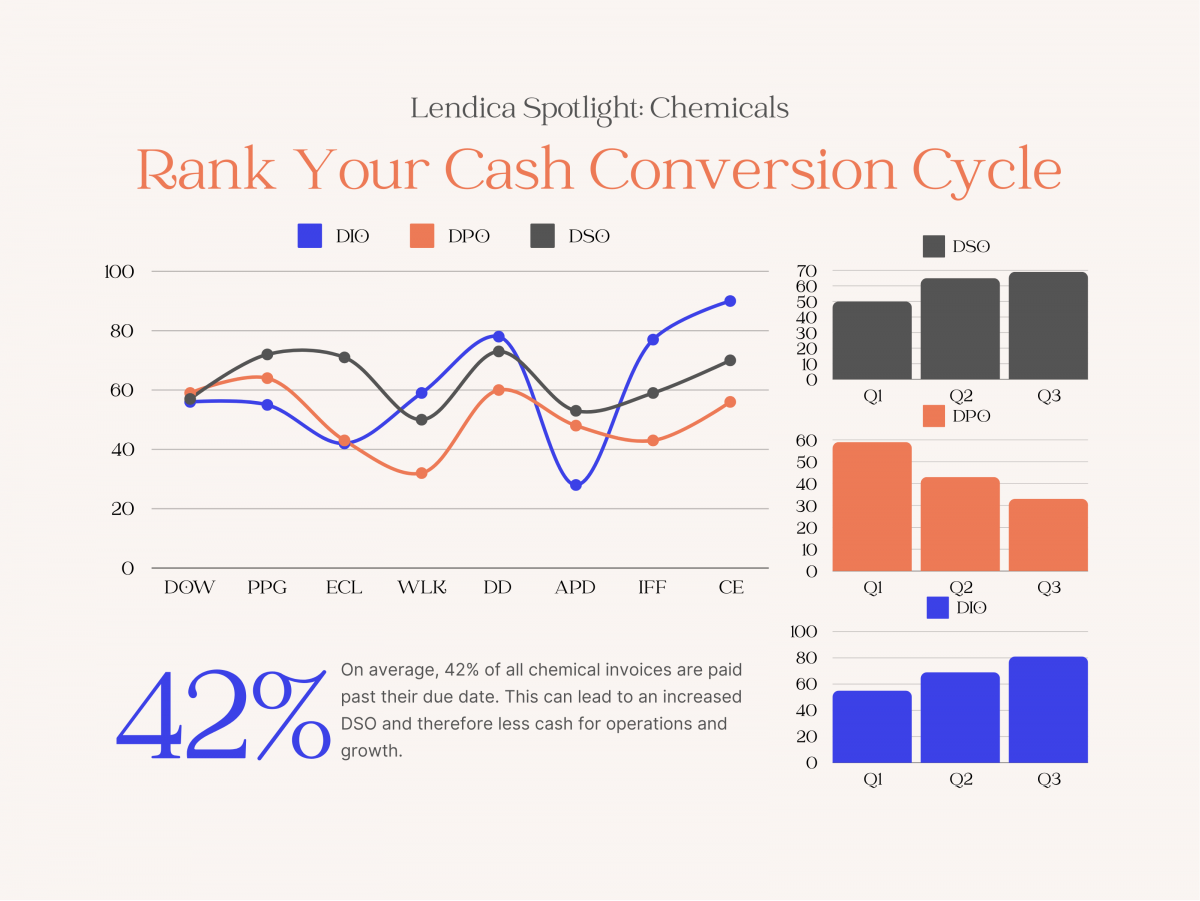
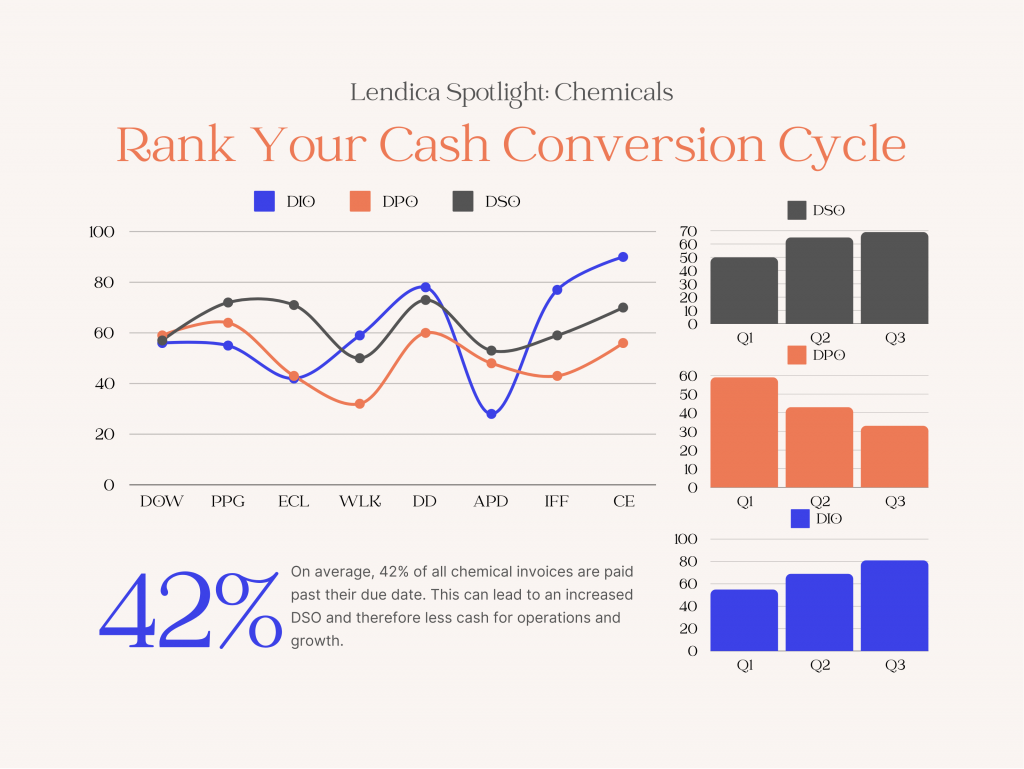
Rank your cash conversion cycle

The chemical industry is experiencing a notable contraction, with an 8% year-over-year sales decline driven by economic uncertainties and shifting market demands. This has compelled industry leaders to tighten their working capital management strategies to sustain financial stability and operational efficiency. Our comprehensive report delves into these adjustments, examining how companies are shortening cash conversion cycles by reducing inventory levels, extending vendor payment terms, and accelerating customer collections.

Our analysis includes an index based on the top 25 publicly traded chemical companies within the S&P 1500, providing insights into key metrics like Days Sales Outstanding (DSO), Days Inventory Outstanding (DIO), and Days Payables Outstanding (DPO). Highlighting the successes of industry leaders such as WD-40 and Scotts Miracle-Gro, as well as the challenges faced by FMC Corporation, this report offers valuable lessons in effective working capital management. Download the full report to uncover in-depth strategies and performance analyses that can help your company navigate the current economic landscape and optimize its financial practices.

Delay supplier payments with PayLater

Learn how you can pay your suppliers early, enjoy early-pay discounts and pay back up to 90 days later.

Learn more

Speed up cash collection with FundNow

Learn how you can get paid upfront on your sales invoices.

Learn more