Categories
Article

Glossary: Defining Commonly Used Financial Terms

Introduction

Welcome to the Lendica Glossary. This comprehensive guide helps to explain key financial terms and concepts relevant to embedded lending and business financing. Whether you’re a small business owner, CFO, or financial enthusiast, this glossary will help you understand essential terms and how they apply to your financial operations.

Terms

2/10 Net 30

A payment term offering a 2% discount if an invoice is paid within 10 days; otherwise, the full amount is due in 30 days. This incentivizes early payment and improves cash flow.

Example Formula:

Discount Amount = Invoice Amount × 0.02

Use 2/10 Net 30 for free finance

Learn a reverse factoring hack for scaling.

Read more

Accounts Payable

Money owed by a business to its suppliers for goods or services received but not yet paid for. Managing A/P effectively is crucial for maintaining good supplier relationships and ensuring the business has adequate cash flow and operational liquidity.

Accounts Receivable

Money owed to a business by its customers for goods or services provided but not yet paid for. Managing A/R effectively is crucial for maintaining cash flow and operational liquidity.

Days Inventory Outstanding (DIO)

Measures the average number of days inventory is held before it is sold.

Example Formula:

If a company has an average inventory of $50,000 and a COGS of $200,000, the DIO would be 50,000/200,000 x 365 = 91.25 days.

Days Payables Outstanding (DPO)

Measures the average number of days a company takes to pay its suppliers.

Example Formula:

If a company has accounts payable of $30,000 and a COGS of $200,000, the DPO would be 30,000/200,000 x 365 = 54.75 days.

Days Sales Outstanding (DSO)

Measures the average number of days it takes to collect payment after a sale.


Example Formula:
If a company has accounts receivable of $25,000 and total credit sales of $150,000, the DSO would be 25,000/150,000 x 365 = 60.83 days.

Embedded Lending

A financial service integrated within a software platform, enabling users to access credit seamlessly. It simplifies the borrowing process and enhances user experience by providing financial services within existing workflows.

Enterprise Value

Enterprise Value (EV) is a measure of a company’s total value, often used as a more comprehensive alternative to market capitalization. It includes the market cap, debt, minority interest, and preferred shares, minus total cash and cash equivalents. EV is useful in assessing the value of a business for potential acquisition.

Example Formula:

Enterprise Value = Market Capitalization + Total Debt + Preferred Shares + Minority Interest – Cash and Cash Equivalents

For instance, if a company has a market cap of $50 million, total debt of $10 million, and $5 million in cash, its EV would be $55 million.

ERP Integration

The process of connecting a company’s Enterprise Resource Planning (ERP) system with other applications to streamline operations and ensure consistent data flow. It improves efficiency and accuracy in financial management.

Factoring

A financial transaction where a business sells its accounts receivable to a third party at a discount to receive immediate cash. This helps businesses manage cash flow and reduce credit risk.

Speed up cash collection with FundNow

Learn how you can get paid upfront on your sales invoices.

Learn more

Factor Rate

A factor rate is a fixed multiplier used to determine the total repayment amount in a merchant cash advance or factoring agreement. Unlike traditional interest rates, factor rates are expressed as a decimal figure, typically ranging from 1.1 to 1.5. The total repayment amount is calculated by multiplying the advance amount by the factor rate.

Example Formula:

Total Repayment Amount = Advance Amount × Factor Rate

For instance, if the advance amount is $10,000 and the factor rate is 1.2, the total repayment would be $12,000.

Reverse Factoring

A financial arrangement where a third party finances a company’s suppliers, allowing the suppliers to get paid early while the company pays the third party later. It enhances supplier relationships and improves cash flow management.

Delay vendor payments with PayLater

Learn how you can pay your vendors early, enjoy early-pay discounts and pay back up to 90 days later.

Learn more

Use 2/10 Net 30 for free finance

Learn a reverse factoring hack for scaling.

Read more

Small Bill Charges

Additional fees that a service provider applies for processing smaller invoices or bills, typically to cover administrative or processing costs. These charges are often implemented to ensure that even smaller transactions remain cost-effective for the business providing the service.

Vertical SaaS

Vertical SaaS is software designed specifically for the needs of a particular industry or niche, such as healthcare or finance. It provides specialized features and solutions tailored to the unique challenges of that sector.

Working Capital

The difference between a company’s current assets and current liabilities, representing the liquidity available for day-to-day operations. Effective management of working capital is essential for maintaining business solvency.

Example Formula:

Working Capital = Current Assets – Current Liabilities

Speed up cash collection with FundNow

Learn how you can get paid upfront on your sales invoices.

Learn more

Delay vendor payments with PayLater

Learn how you can pay your vendors early, enjoy early-pay discounts and pay back up to 90 days later.
Learn more
Categories
Article

Competitive Analysis: Which Embedded Lending Platform is Right for Me?

Which Embedded Lending Platform is Right?

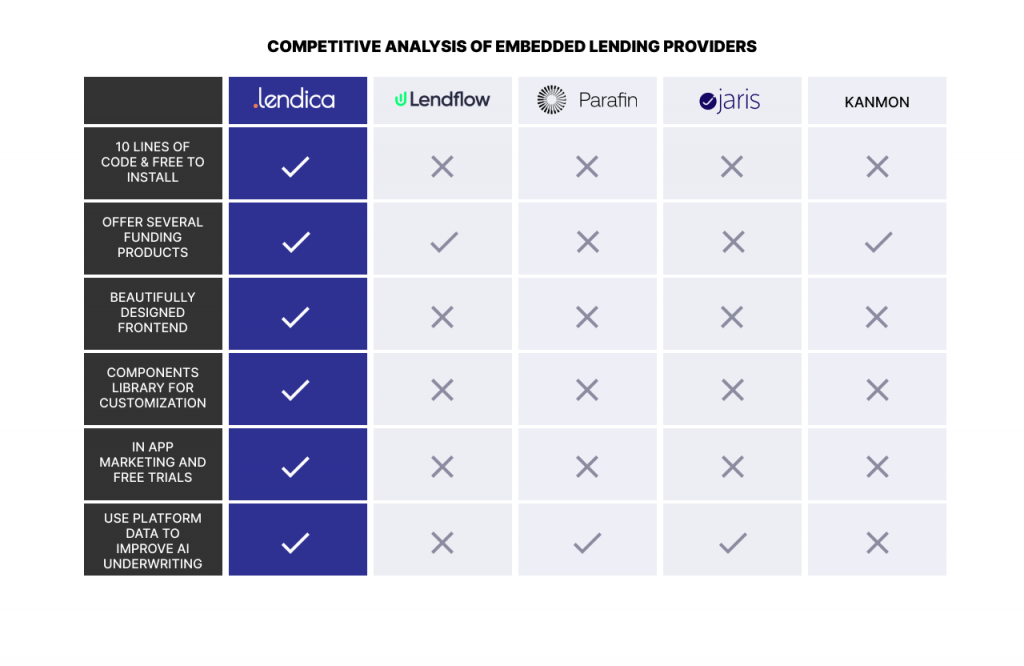
There are five major companies serving the embedded lending space: Lendica, Lendflow, Parafin, Jaris, and Kanmon.

Based on our experiences embedded lending products over the past several years, we have found the top five categories that companies (Vertical SaaS, POS, ERP, Marketplace, eCommerce, etc) look for when making their embedded lending decision.

These categories include

  • Speed and ease of installation
  • Product design and functionality
  • Loan products, approval rates, and terms
  • Ongoing costs to market the product to their customers, and
  • Continuous platform improvement

We compare all five companies and conclude that Lendica, Lendflow, and Parafin have advantages in the following categories.

  • Best embedded solution: Lendica
  • Best embedded broker: Lendflow
  • Best alternative to Lendica: Parafin

Easy to Install

The first step to consider is the cost to install your embedded lending solution. There are explicit and implicit costs to be aware of. The embedded lender may offer the installation for free, such as Lendica, and generate its revenue on success (i.e earning fees for good loans). Be warned that some solutions, Lendflow for example, will charge upwards of $1,200 per month to install the service.

The implicit cost is typically much higher. Some embedded lending solutions, such as Kanmon, can be quite labor intensive to install. Companies seeking to embed lending products should be aware of the development time spent to build the integration. Lendica’s embedded lending product is designed to be “off-the-shelf” with the ability to customize. Partners can actually install Lendica with just a few lines of code and it can be activated in minutes. To demonstrate, we bought a Tesla with Lendica in just a few minutes.

Based on our analysis of integration time and explicit cost, we estimate that most software companies can be up and running, at scale, with Lendica 10 times faster and most cost effective than most other embedded lenders.

Lendica’s industry leading embedded lending solution is 10x better than the market.

Simple to Use

An important next step to consider is the product design and use. Aesthetic appeal in software isn’t just about good looks—it can greatly influence user behavior. An appealing, modern interface attracts customers and entices them to explore further. Lendica’s product is visually engaging and designed with user experience in mind. This ensures customers feel comfortable and attracted to the software, thereby increasing the probability of continued usage and loyalty.

Ease of use is another significant determinant when choosing software solutions. The ability for users to understand and navigate the product efficiently without needing extensive training or support is crucial. The more questions your customers ask, the most expensive the embedded solution becomes as it requires servicing and updates. With an intuitive interface and features, Lendica significantly reduces the learning curve for new users. This accelerates the adoption process, saving software companies valuable time and resources, and leading to quicker returns on their investment.

Design is a difficult category to quantify, so we invite you have a look at Lendica’s product and decide for yourself.We estimate that, aside from a design advantage, the intuitive and inviting nature of Lendica’s product can dramatically increase conversion by more than 10x compared to other embedded lenders.

More Customer Approvals

There are two factors that the decision-maker should consider as it relates to approvals: product mix and underwriting strength. More products equate to more approval opportunities, catering to a broader range of customer needs. Lendica’s approach in offering four funding products demonstrates its understanding of varied customer profiles and their unique requirements. Unlike some platforms such as Jaris and Parafin, which only offer merchant cash advances, Lendica ensures flexibility and inclusivity by providing a broader product mix.

Lendflow, although not a direct lender themselves, does offer customers a wide variety of funding products through its broker network. End customers that are interested in a loan will share some data with Lendflow which will in turn market their business file to its audience. It should be noted that while this does widen Lendflow’s product offering, it does dramatically increase the costs to the end-customer.

Strong underwriting methodologies are key to the success of any lending platform, as they contribute to lower rates by reducing defaults. Lendica’s AI-powered underwriting engine incorporates partner platform data, thereby gaining a more detailed and accurate understanding of risk. This information-driven approach leads to a robust underwriting process and therefore industry-leading approval rates. Parafin, although focusing on only one funding product, does tend to use platform data to make underwriting decisions similar to Lendica.

Built-in Marketing

The ongoing marketing efforts towards the end customers in the embedded lending space can indeed pose significant costs and time expenditure. Companies considering embedded lending should assess the marketing budget to nudge the customers towards the product.

We believe Lendica is the only embedded lender directly address this concern by integrating a unique in-app marketing engine. This feature serves a dual purpose – it substantially reduces the associated marketing costs and concurrently enhances customer engagement. Lendica’s built-in marketing engine eliminates the need for separate, costly marketing initiatives. Instead, it delivers relevant, targeted messages and prompts within the app interface itself, keeping customers informed and engaged, which ultimately fosters a deeper relationship with the user. Importantly, these features are customizable and can be turned on/off as directed.

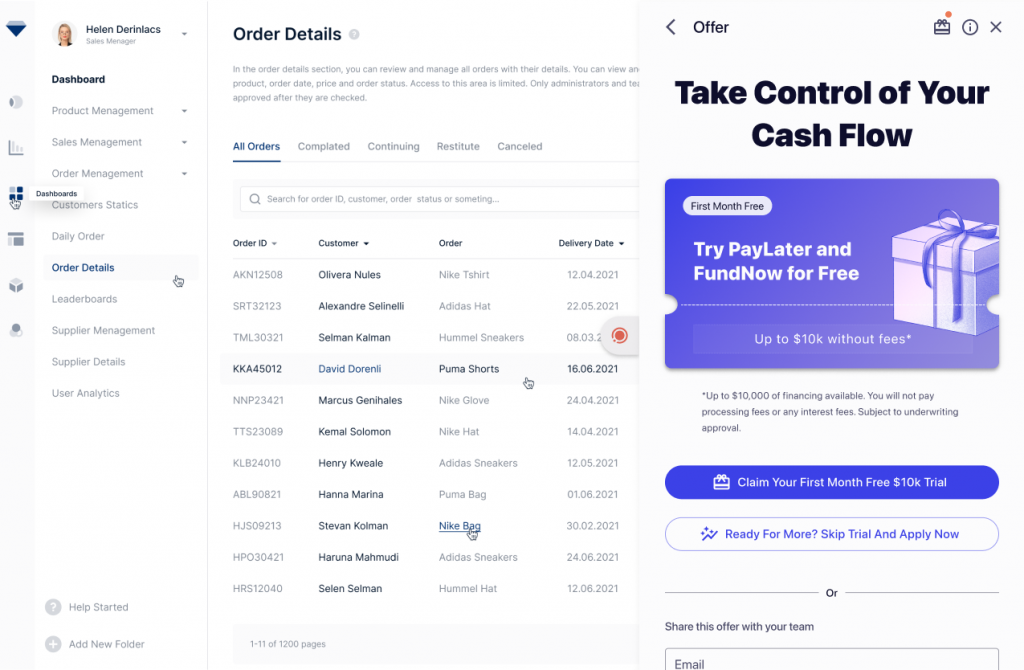
Lendica offers free trials to its customers, embedded right into their everyday workflow.

Lendica also offers in-app campaigns, including free trials, designed to entice potential customers and provide them an opportunity to experience the product first-hand. This proves to be a powerful conversion tool – customers can get up to $10,000 free to try – and comes at no cost to the partner.

The goal of these in-app marketing features is to improve the per-dollar conversion by 100x any other embedded lender. We believe that this is currently the case.

Continuous Innovation

When you embed a lending product, you are not just betting on a great service today, but rather a great service for years to come. For that reason, Lendica remains focused on continuous innovation.

Each new feature Lendica develops is guided by three fundamental questions. First, will it enhance the customer’s embedded experience? Second, can it reduce the costs per conversion for the partners? And third, does it have the potential to change how small businesses access financial services? These considerations ensure that Lendica’s enhancements not only serve immediate needs but also propel the future of small business financial success.

Choosing Lendica is not simply a choice for today; it’s an investment in a service that evolves and adapts to future needs. The rapid progression of the fintech industry necessitates a responsive and proactive approach to innovation. Lendica embodies this by continually improving its services to meet and exceed the changing needs of customers and partners. As such, the decision to embed Lendica’s lending product is a commitment to long-term growth and transformation.

Conclusion

In conclusion, the future of embedded lending clearly lies in services that are fast, efficient, user-friendly, and innovative. Lendica is at the forefront of this evolution, with its quick and easy installation, sleek product design, improved loan approval rates and terms, reduced marketing costs, and soon-to-be-unveiled AI enhancements. It’s not just about providing a service but creating an ecosystem where businesses can flourish with minimal barriers and maximum support. While competitors may offer pieces of the puzzle, Lendica brings them together, presenting a complete picture that is greater than the sum of its parts. This is why we confidently say Lendica provides a 10x advantage. Embrace the future of embedded lending with Lendica, and experience a seamless financial journey tailored to your unique business needs.

Categories
Article

Take Control of Your Business Cashflow with Lendica

Small Business Cashflow Toolkit

In the dynamic world of small businesses, managing cashflow effectively is a critical success factor. Lendica, a provider of affordable, on-demand finance, offers a cashflow toolkit with three distinct products designed to help small businesses better manage their cashflow. These three products – PayLater, FundNow, and PayLater for Your Customer – offer unique benefits that can significantly enhance a company’s financial stability and growth potential.

The first of these products, PayLater, is designed to boost a company’s buying power by delaying payments to vendors. This innovative tool allows businesses to increase their order sizes without the immediate financial burden, thereby qualifying for quantity discounts and improving their profit margins. For instance, a small retail business could use PayLater to purchase larger quantities of inventory at a discounted rate, thereby increasing their profit margin when these items are sold. Moreover, PayLater helps businesses smooth out vendor payments, thus avoiding sudden shocks to their bank balance. This can be particularly beneficial during periods of unexpected expenses or lower-than-expected revenues, as it allows businesses to maintain their operations without the stress of immediate large payments.

Lendica’s funding toolkit helps small businesses stay competitive and reach scale faster.

FundNow, the second product in Lendica’s suite, is aimed at accelerating the collection process from customers. With FundNow, companies can get paid immediately on client invoices, enabling them to reinvest in inventory, marketing initiatives, or other business growth opportunities without having to endure painful delays in collection. For example, a small manufacturing company could use FundNow to immediately reinvest in raw materials, rather than waiting for customer payments to come in. This immediate access to funds can significantly improve a company’s operational efficiency and financial health, allowing them to seize opportunities as they arise.

Lendica’s third offering, PayLater for Your Customer, is a tool that allows companies to offer flexible payment terms to their customers while ensuring they get paid upfront. This product is free to use and provides a win-win situation for both parties. Companies get paid immediately upon delivery, while their customers enjoy the flexibility of extended payment terms. For instance, a small business selling high-ticket items like furniture or electronics could use PayLater for Your Customer to offer their customers the option to pay in installments, thereby potentially increasing sales while still ensuring immediate payment upon delivery.

In conclusion, the suite of products can have a major impact on how small businesses manage their cashflow. By using tools that delay vendor payments, speed up customer collections, and provide flexible payment terms to customers, small businesses can better navigate financial challenges and refocus on their core competencies. These innovative solutions not only enhance a company’s financial stability but also contribute to its growth and success in the competitive business landscape.

Categories
Article

Embedding With Lendica: The Perfect Opportunity in Today’s Financial Landscape

In a rapidly evolving financial climate where traditional banks are falling short on lending, tech companies are presented with an opportunity to help. Embedding lending into SMB platforms, such as marketplaces, vertical SaaS, and tech-enabled distributors, can provide an efficient, elegant solution to this growing concern. We discuss some of the major benefits to adding an embedded lending stack in today’s market.

A Gap in the Market

The primary driver in the current financial landscape is the reluctance of banks to lend. Banks’ reticence has left hundreds of thousands of businesses with inadequate resources to navigate these challenging times. By embedding a lending solution into your customers workflow, you are signaling to your clients that you care about their concerns. Importantly, because Lendica is both the technology provider and the balance sheet, you can be rest ensured that capital continues to flow directly to your customers, filling the gap left by traditional banks.

The world’s most powerful, versatile, all-around-good-time-of-an embedded lending platform.

Additional Revenue Streams

As we’re faced with a challenging economic climate, we have found many software businesses looking to explore new ways to generate revenue. Integrating lending solutions into existing platforms introduces a new revenue stream with limited technology spend. By embedding Lendica’s lending solutions, technology companies can quickly stand up a lending solution – typically in two to four weeks. The income earned from loan origination fees and interest can diversify revenue streams and strengthen the bottom line to face difficult market head on.

Enhancing User Experience

User experience is key to success in the tech industry. By offering a seamless lending process, companies can significantly improve their user experience. With Lendica, users won’t have to switch between different platforms to access lending services. Instead, they’ll find everything they need in one place – a one-stop-shop approach that greatly enhances user convenience.

The current economic landscape presents a perfect opportunity for tech companies to explore embedded lending. With traditional banks shying away from lending and businesses seeking ways to remain resilient, integrating a lending solution like Lendica can be a game-changer. It empowers customers, boosts revenues, enhances user experience, and above all, it fills a critical gap in the market, making this a perfect time to embed with Lendica.

Categories
Article

Why Hansa Chose Lendica Over Lendflow: A Better Lending Solution for Small Businesses

Introduction:

Hansa, a novel, free tool designed to help small business owners maintain accurate and consistent financial data, had recently been on the lookout for an embedded lending platform to offer loans to its customers. After considering Lendica and Lendflow, two major providers in the industry, Hansa ultimately decided to partner with Lendica. In this article, we will explore the reasons behind this decision and why Lendica’s solution proved to be the better choice for Hansa and its customers.

Fully Embedded Solution

One of the primary reasons Hansa chose Lendica over Lendflow is the fully embedded nature of Lendica’s solution. Lendica’s platform seamlessly integrates with Hansa’s existing systems, allowing for a streamlined and user-friendly experience. This means that small business owners can access instant digital loan products directly through Hansa’s platform without having to navigate through multiple websites or applications. Lendica’s application can be pre-populated with Hansa’s customer data making it even easier for small businesses to access capital in these trying times.

Lendica’s iBranch embeds lending anywhere.

Secure Data Transfer

In today’s digital age, data security is paramount. Lendica’s platform ensures that the business data exchanged between Hansa and financial service providers is securely transmitted, maintaining the privacy and integrity of sensitive information. On the other hand, Lendflow’s embedded web form was unable to offer the same level of data security, which is a critical factor for businesses dealing with financial data.

Instant Decision Making

Hansa’s primary goal is to provide small business owners with a seamless experience when seeking financial assistance. Lendica’s platform offers instant decision-making capabilities, allowing customers to receive loan offers in real-time. This not only saves time for business owners but also helps them make informed decisions quickly. In contrast, Lendflow’s solution could not provide instant decisions, which may lead to delays and hinder the overall user experience.

Customization and Scalability

Lendica’s platform is highly customizable and scalable, allowing Hansa to tailor the lending experience to the specific needs of its customers. This flexibility ensures that the platform can grow and adapt alongside Hansa’s user base, providing continued support and resources to small business owners. Lendflow’s solution, however, lacked the same level of customization and scalability, potentially limiting its effectiveness in meeting the diverse needs of Hansa’s customers.

Conclusion:

After a thorough evaluation of both Lendica and Lendflow, Hansa has confidently chosen Lendica as its embedded lending platform partner. Lendica’s fully embedded solution, secure data transfer, instant decision-making capabilities, and customizable platform offer a superior lending experience for small business owners. By partnering with Lendica, Hansa reaffirms its commitment to providing top-notch financial support and resources to its customers, empowering them to grow and succeed in today’s competitive business landscape.

Categories
Press

Lendica Releases Instant-Approval Lending Options from Salesforce and Shopify

BOSTON, Feb. 1, 2023 /PRNewswire/ — Lendica, a Boston-based financial software company, announces new integrations for its growing line of embedded finance products.

Background

Lendica is an embedded finance company that is building an automated lending machine. The company embeds instant-decision, B2B payment and lending products to promote faster funding and better rates. Lendica has added Shopify and Salesforce integrations to its growing list of digital headquarters, defined as ERP, POS, Marketplace or other applications where operators spend the majority of their time managing their business.

The Boston-based fintech has spent the last several years building software to automate all functions of the lending ecosystem. Lendica’s iBranch, short for integrated branch, is a full-service lender made accessible directly from a business’s digital headquarters. Lendica’s underwriting software, Lens, allows applicants to seamlessly share data – several times more than traditional lenders can process – and uses advanced modeling to quickly and more accurately predict default. The company is growing more than 10% month over month and adding new integrations in industries like chemicals, food and beverage, and restaurants.

Lendica’s Co-founder/CEO, Jared Shulman, CFA, spent time at a private credit hedge fund researching fintech and marketplace lenders. “Five years ago, we began to observe a sea change in borrower behavior.” shares Shulman, “Businesses had noticeably shifted their borrowing preferences away from banks and towards software businesses like Amazon and Toast. We founded Lendica to optimize the borrowing experience for small and medium-sized businesses from the comfort of their favorite operating software.”

Enter Salesforce and Shopify

Lendica’s integrations are now available from two of the largest business applications – Shopify and Salesforce. Customers can use Lendica’s PayLater and FundNow products to delay payments to their vendors or speed up collection from wholesale accounts with just a few clicks.

These B2B lending transactions can be critical for businesses looking to scale during economic slowdowns. This is especially the case for businesses with complex supply chains like manufacturers, wholesalers, and CPG brands – many of which experience top line growth but still need better access to capital. Ascent Solutions, an ERP built on Salesforce with several hundred startup and SMB customers, is an early embedded-finance adopter.

“We work with customers that have grown from fledgling startups to publicly traded companies,” explains James Gaines, CTO at Ascent Solutions. “In advance of rapid growth phases, good funding sources are not always readily available for many companies. Lendica’s Salesforce integration was easy to install and has a beautiful UI—we’re excited to add it to the Ascent Financial Package (AFP). Soon, business leaders will be able to leverage fairly-priced financing products directly from Ascent Solutions in Salesforce with the click of a button.”

Lendica’s proprietary underwriting engine is behind the seemingly simple, instant-decision loan offers. “Business datasets are chaotic,” states Jerry Shu, Lendica’s Co-founder/CTO. “The power of Lendica’s Lens is its ability to input many different datasources and fit them to a universal schema, or Token. This allows us to underwrite a business based on their real-time revenues and costs instead of bank balances and transactions. Lendica can be plugged into any operating software, whether Salesforce, Shopify or an independent ERP, and leverage the same Token.”

For businesses powered by Shopify, Lendica’s PayLater extension allows B2B wholesalers and distributors to offer seller terms at checkout. The easy to install tool adds flexible financing options right at the purchase point – often increasing order sizes and welcoming back repeat customers.

To learn more about Lendica’s Salesforce and Shopify integrations, please visit golendica.com. To learn more about Ascent Solutions, please visit ascenterp.com.

Categories
Article

How this Cicis Franchise Owner Plans his Pizza Empire with Lendica and Plum POS

Planning a Pizza Empire

Greg Smith, the proud owner of three Cicis franchises in the Central Texas region, has been rocking and rolling.

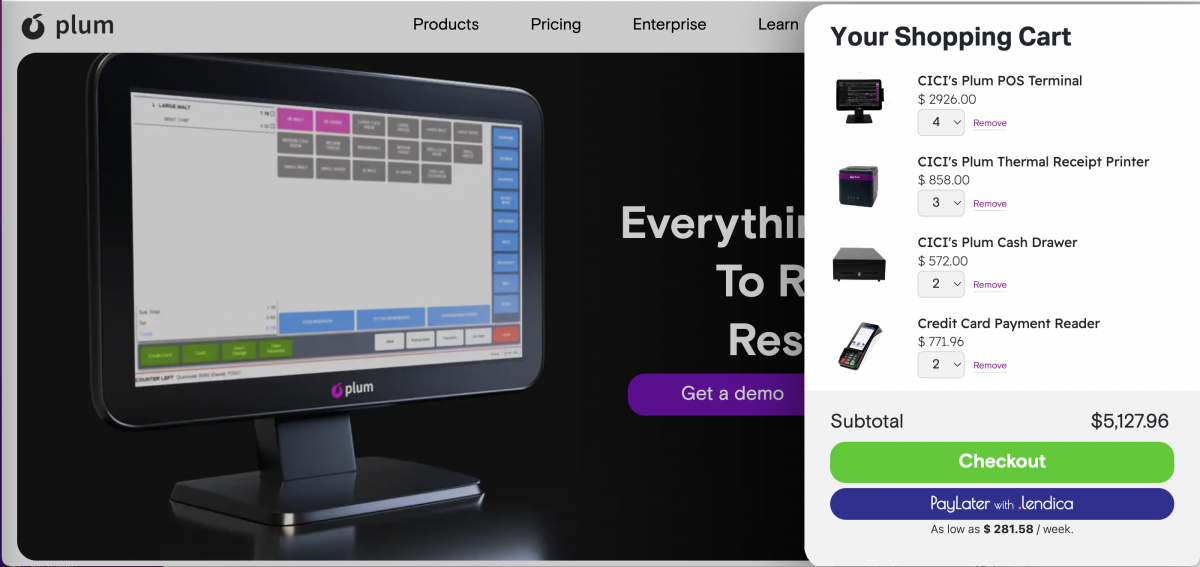
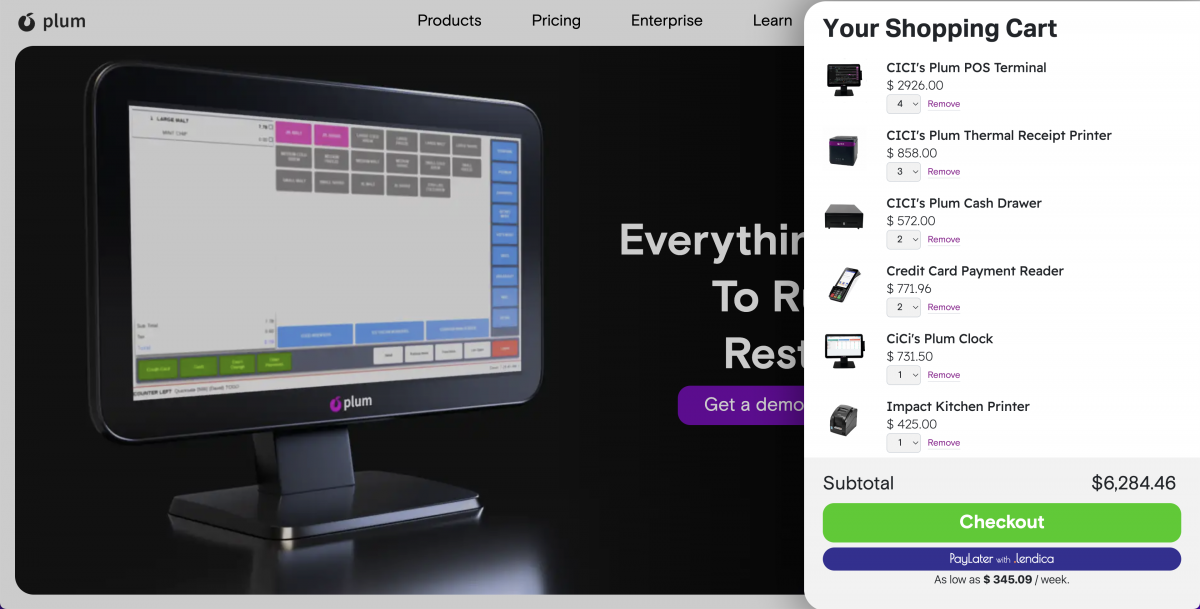
Like many of his fellow Cicis franchisees, Greg has been watching sales steadily increase across his three locations. He’s been pleased to welcome in new customers and welcome back the regulars even more – so much so that he believes it may be time to upgrade. The first step was equipment. Greg, along with fellow Cicis owners, began by updating their Point of Sale set-up to the Plum POS bundle. At checkout, Smith came across the option to PayLater with Lendica.

Lendica’s B2B PayLater option was built to help small and medium sized businesses spread the upfront cost of certain purchases over several weeks. Greg followed the four step application and, in under two minutes, he was approved to pay his $4,616 bill in 5, 10, or 20 smaller installments. He opted for 10 weekly payments of just $470.

Once completed, Greg was directed to Lendica’s customer portal. He was pleased to find that, much to his surprise, his total credit available was $55,600 – far more than the small POS purchase. Since Greg’s business was in good shape and he had been managing his funds appropriately, Lendica was able to automatically qualify him for more capital without the need for an additional application. His credit facility was already available for use! Greg plans to use this line of credit to begin upgrading his stores and is working with the Lendica credit team on additional capital for his arcade renovations and acquisition of new locations.

“The experience with Lendica has been really great,” according to Greg. “The PayLater application was fast and simple and the rates were fair. The fact I can use Lendica for even more equipment and renovation is awesome, too. We’re looking for a partner that can take us to the next level and it seems like we’ve found it.”

Lendica is happy to provide instant, quality capital solutions for Cicis Pizza and many more franchise networks. To learn more, visit Lendica at golendica.com.

Categories
Press

Lendica Launches Instant Approval B2B Payment Plans with Altametrics

Boston, MA (PRUnderground) October 17th, 2022

Lendica, a Boston-based software company, announces the roll out of instant-approval payment plans with Altametrics.

Altametrics, a leading provider of Enterprise Labor & Inventory Management Software Solutions for restaurants, is teaming up with the tech company to help customers easily purchase its newest line of PlumPOS equipment. Cici’s Pizza, a Texas-based pizza franchise powered by Altametrics, was the first to announce the option to their customers and it has been well received – more than 30% of its franchisees have discovered the option to spread the $5-10k purchases across several months instead of upfront.

“We applaud Altametrics for their focus on ease of use, customer support, and quality underwriting,” says Jared Shulman, Lendica Co-founder/CEO. “The Altametrics’ team, with strong support from Cici’s, aided in a two-week installation of our embedded software package and provided helpful insights to promote instant, risk-based decisioning. This is a win for the franchise owners, who can enjoy as low as 5% APR financing, and small businesses everywhere who can benefit from our suite of reliable, instant funding tools in action.”

Embedded finance, as described in detail throughout Lendica’s website, brings a promise for better financial tools. Small business owners may be the ultimate beneficiary. “Small businesses have more accessible data than ever before,” explains Jerry Shu, Lendica’s Co-founder/CTO. “The trove of intel that lives in the small business’s digital headquarters – our term for SaaS providers like Point of Sale, Enterprise Resource Planning, or eCommerce platforms – can be used by lenders to quickly build an extensive risk profile, or Lendica ID, and power robust analysis for instant credit decisions. Better data means better prices for small businesses across all regions and industries.”

Lendica has been quickly growing in the embedded finance space with a list of major partners seeking to adopt its technology. “We believe the future of banking is pretty simple,” says Shulman. “Give people the tools to finance their decisions from the places that inspire them.”

About Lendica

Lendica is a truly embedded finance company focused on smart lending. We provide simple and transparent funding solutions for businesses at the point of decision. Businesses today rely on many technology vendors to make and execute decisions – process payment, make deliveries, purchase inventory, manage invoice, etc. Lendica creates integrated technology which enables tech vendors to provide their clients instant access to capital and help them finance these decisions and grow their business.

Categories
Article

The New Normal in B2B Finance

The New Normal

At Lendica, we spend a lot of time (read: like, a lot) talking about and building towards the future of finance. Here is how we see it, for those eager to waste a few more minutes.

What is a payment? What is a bank? What (the heck) is a fintech? It seems like, faster than you can say “who’s leading the round?!,” the answers are changing.

We recently launched a partnership with Altametrics – the powerhouse technology shop supporting Chipotle, TacoBell, Jamba Juice, and more – and in a matter of two weeks, they have gone from a tech firm to a tech firm that “oh by the way can also instantly qualify and fund you for a loan-type product.”

PayLater with Lendica is an instant payment plan product available on PlumPOS

How is this possible?

Great software for starters 💁‍♀️. More than that, it’s built on the back of a major surge in demand for financing in peculiar places.

“…the [fintech movement] has gone mainstream and people now expect financing products at their fingertips.”

This trend certainly isn’t new – we’d be remiss not to mention the Big A.S.S lenders (Amazon, Shopify, and Square) who led the charge. BNPL giants (read: not at press time) like Affirm and Klarna also get their credit.

In the B2B space, the movement has gone mainstream and people now expect financing products at their fingertips. Companies like Balance, Gynger, and OatFi have taken notice and are building tools in pursuit of glomming on. Customers, especially small and medium-sized businesses, stand to benefit from the influx of targeted software and capital.

With VC money pouring in, payment and finance products on your every screen may very well be the new normal in the B2B world. Show us the odds on Clippy’s come back, “I see you’re typing an invoice.”

What will happen?

The question remains: will the fintechs “play nice?”

When a fintech company integrates with a software provider – Enterprise SaaS, ERP, POS, or ISV – to offer customer’s financing products, they are building what is called a captive market. A captive market is the equivalent of a beer at the ball park. It hits the spot… but for $15?? I guess it’s better than leaving for a six pack…

The convenience may be worth the price, but we believe ease shouldn’t be served at a premium. We’d like you to imagine Coors, Bud, and Miller competing over the sale, right from your seat.

At Lendica, we are on a mission to establish the future new normal in B2B finance – captive market with competitive prices. We draw inspiration from the mortgage, auto, and consumer credit markets.

In the meantime, we are pleased to be a part of the pack pushing for embedded payments, instant lending, and bringing back Clippy.

Categories
Article

How big agg data can help you swallow your burger with a smile

Easterday Farms

Ranchers and their enthusiasts are all too familiar with the tragic story of Easterday Farms. To our audience not yet acquainted with Gale Easterday, formula contracting, or the capitulation of the single family ranchers of America – inch a little closer.

The event which ended in unraveled fraud and a deadly car crash can be summarized, bluntly and apologetically, as an information and incentive mismatch. As entrepreneurs, we empathize with the outcome. As lenders, we recognize the need for change.

To say that big data could have helped avoid the event would be a bold claim. The reality is a more transparent, dynamic system can help ranchers fight back against formula contracting. Importantly, a better alternative to formula contracting can lead to happier ranchers, and thus, maybe even better burgers.

Allow us to explain how.

The cattle ranchers of America are getting squeezed like an udder.

Too big to scale?

Feeding America, the NGO fighting Hunger, places emphasis on scale. Bigger producers and bulk orders means lower prices and better food access. As a result, the price of beef has steadily dropped over the past 20 years. Many ranchers, especially those producing under 50,000 pounds of livestock, are folding under the pricing pressure.

The four major cattle buyers in America – Tyson, JBS, Cargill, and Marfrig – have hit scale through several financial instruments. The most complex, and fastest growing, is called formula contracting. Basically a loan-to-own on young calves, formula contracting is an agreement to prepay ranchers on their calves and buy them back at the market price, plus interest, at their finishing age. 

Small ranchers with cash flow issues rely on this tool to stay afloat. Margins have tightened and, almost in lockstep, the formula contract practice has expanded – today more than 70% of cows are under such terms. 

The buyer is the lender

The danger with these contracts lives in the buyback clause. The buyback price is set on the CME – market participants which include speculators, day traders, and, of course, cattle’s big four. Tyson and gang, already under close watch over shady chicken price practices, have a clear economic incentive to lower the market – especially during the buyback window. 

When a lender finances an operator against their inventory, they are betting on the business and its goods. In a good outcome, the business sells its inventory and pays off their debt. Alternatively, the business defaults and the lender liquidates the inventory into the free market. 

Formula contracting is a different story. The better outcome for Tyson is a default scenario. If the price of cattle takes a hit, the buyer’s purchasing power increases. They receive their cattle at a much lower rate, collect interest, and if the rancher cannot pay can trigger aggressive default clauses. 

Since the rancher cannot sell their only major asset to “the market,” they have no choice but to meet the buyer’s demands. This may include giving up more cattle, racking up penalties, or even losing their farm.

For those arguing the market price is set by the CME and it’s impossible to arbitrage the transaction, remember this: private cattle transactions do not have to trade at listed prices. If a bad actor artificially deflates the futures market, the rancher can still sell off-market at a fair price. That is not an option when there is only one buyer

Create a new system

Though flawed, the formula contracting system is built on some solid ground. The ranchers need a cash advance on their future cattle sales. The lender needs protection for its risk. We believe the solution lies in introducing a third party.

When a third party lender can properly assess risk and contract in the free market, the operator wins. The business has more latitude to manage their cash flow without an imposing threat of a “margin call” (frankly, they have enough to worry about).

Third party lenders should also have an edge in underwriting. Granted Tyson & Co. have an intimate knowledge of the ranching market, we believe that risk can better be quantified using data. Today’s smart lending outfits look more like Facebook than Bank of America with engineers building tools to measure and track risk. Tyson failed to recognize millions of Easterday’s cattle left unaccounted for. A cutting edge lending software may have caught such malpractice.

Lendica’s We Heart Ranchers Program

At Lendica, we want to put an end to formula contracting using, you guessed it, lots of data. Today, savvy ranchers are using state of the art ranch-management software to track cattle, monitor feed, and process billing. That same software can soon be used to share information with lenders and quickly offer financing. Lendica believes that by empowering ranchers to seamlessly share their data, easily understand loan documents, and instantly access capital we can build a more sustainable credit infrastructure for the ranchers of America. And, with that, hopefully a better burger. 

To learn more about the Lendica We Heart Ranchers or sign up for our waiting list, click here.